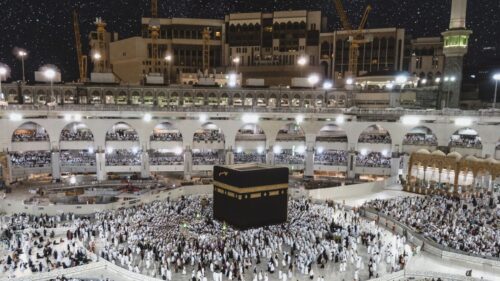


Zamzam water (Arabic: مَاءُ زَمْزَم) is the blessed spring water that flows from a well roughly twenty metres east of the Ka’bah inside Masjid al-Haram in Makkah. It first miraculously gushed forth about four thousand years ago, when the infant Prophet Ismail (AS) was left with his mother Hajar in a barren valley by command of Allah. The Prophet Muhammad (ﷺ) called it “blessed” and “a healing for sickness,” as recorded in Sahih Muslim 2473a and Sunan Ibn Majah 3062.
This guide covers what Zamzam water actually is, the full Hajar and Ismail story, the canonical hadith with their sunnah.com reference numbers, the dua to recite when drinking it (with Arabic, transliteration and meaning), the etiquette of drinking, what peer-reviewed science says about its mineral composition, the 2011 safety controversy and the Saudi rebuttal, and the fatwa on whether you can sell Zamzam water.
Table of Contents
What Is Zamzam Water?
Zamzam water is the spring water that issues from a well located inside Masjid al-Haram in Makkah, roughly twenty metres east of the Ka’bah. The well itself is about thirty metres deep and has been continuously flowing for around four thousand years — from the time Hajar (AS) and her infant son Ismail (AS) were left in the valley of Bakkah by Prophet Ibrahim (AS) on the command of Allah.
The name Zamzam is most commonly understood from the words Hajar exclaimed when the water began gushing uncontrollably from the earth: “zamī, zamī” — meaning “stop, stop” — as she tried to contain the spring to keep it from flowing away. Some scholars also link the root to the very abundance and continuous murmuring sound of its flow. Today the well is regulated, sterilised and distributed by Saudi Arabia through the King Abdullah Zamzam Water Project at Kudai, with real-time monitoring by the Saudi Geological Survey’s Zamzam Studies and Research Center.
Drinking Zamzam is a deeply rooted Sunnah of Hajj and Umrah, and the Prophet Muhammad (ﷺ) himself drank it, carried it back to Madinah, and praised it in multiple authentic hadith. Pilgrims drink it on the Day of Arafah, after tawaf, after sa’i, and many save a portion to take home as a tabarruk (blessing) for their families. For Muslims worldwide who have not yet performed Hajj, bottled Zamzam is a tangible link to the Sacred Mosque and a reminder of Allah’s mercy in the face of Hajar’s tawakkul.
Key takeaways:
- Zamzam is the spring that first gushed forth as a miracle for Hajar and the infant Ismail (AS) about four thousand years ago, located about twenty metres east of the Ka’bah inside Masjid al-Haram.
- Two foundational hadith define its virtue: “The water of Zamzam is for whatever it is drunk for” (Sunan Ibn Majah 3062, Jabir RA) and “It is blessed, it is food that nourishes” with the extended chain adding “and a healing for sickness” (Sahih Muslim 2473a, Abu Dharr RA; al-Bazzar 1171).
- The classical dua before drinking is the one reported from Ibn Abbas (RA): Allāhumma innī as’aluka ‘ilman nāfi’an, wa rizqan wāsi’an, wa shifā’an min kulli dā’in — recorded in Sunan al-Daraqutni 2738 and al-Mustadrak of al-Hakim 1/473.
- Etiquette: face the Qibla, say bismillah, drink standing if possible in three breaths, make a specific intention, then say Alhamdulillah afterwards.
- Modern data: TDS around 835 mg/L, pH 7.9–8 (slightly alkaline), and the Saudi Geological Survey’s Zamzam Studies and Research Center monitors the well in real time. The 2011 BBC nitrate/arsenic claim referred to unauthorised bottles abroad — well-source samples tested at King Fahd University showed Zamzam meets WHO drinking-water standards.
The Story of Zamzam: Hajar, Ismail and the Miracle in the Desert
The story of Zamzam is narrated in detail by Imam al-Bukhari in his Sahih. Prophet Ibrahim (AS) was commanded by Allah to take his wife Hajar and their infant son Ismail (AS) to the barren valley of Bakkah — the site of what would later become Makkah. He left them there with a small skin of water and a bag of dates, and turned to leave. Hajar called out, asking him whether Allah had ordered this. When Ibrahim (AS) said yes, she famously replied: “Then He will not let us perish.”
When the water ran out, Hajar’s milk dried up and her infant cried in thirst. Unable to bear the sight, she ran to the nearest hill — Safa — and scanned the horizon for any traveller who could help. She saw no one. She descended into the valley, then ran up the opposite hill, Marwa. She ran between Safa and Marwa seven times in this desperate search. This is why, to this day, the sa’i — the rite of running seven times between Safa and Marwa — is an obligatory part of both Hajj and Umrah, honouring Hajar’s trust in Allah.
On her seventh circuit, she heard a voice. The angel Jibreel (AS) had appeared, and he struck the ground near the infant Ismail with his heel (in another narration, with his wing), and water gushed forth. Hajar, fearing the spring would drain into the sand, began heaping earth around it and saying “zamī, zamī” — “stop, stop.” The Prophet (ﷺ) said: “May Allah have mercy on the mother of Ismail. Had she left Zamzam alone, it would have become a flowing stream.” Jibreel reassured her: “Do not fear neglect. This is the House of Allah which will be built by this boy and his father, and Allah never neglects His people.” (Tafsir Ibn Kathir, drawing on Sahih al-Bukhari 3364.)

The Rediscovery by Abd al-Muttalib
Over the centuries between Prophet Ismail (AS) and the Prophet Muhammad (ﷺ), the location of the well of Zamzam was buried and lost. The tribe of Jurhum, who had become custodians of Makkah, fell into corruption; before they were expelled from the city they buried two golden gazelles and a quantity of weapons inside the well, then covered the well itself to hide its exact location.
Related:


Around fifty years before the birth of the Prophet (ﷺ), his grandfather Abd al-Muttalib ibn Hashim was instructed in a series of dreams to “dig Tibah” — another name for Makkah — and was given precise descriptions of where to dig. Acting on the dreams, and with the help of his son al-Harith, he uncovered the well shaft and recovered the buried treasures. From that day, his clan held the privilege of siqaya — providing water from Zamzam to pilgrims. That duty later passed to the Prophet (ﷺ), to his uncle al-Abbas (RA), and through the Abbasids became a public service of the Muslim state, which it remains to this day.
Zamzam in the Sunnah — What the Hadith Say
The hadith corpus preserves several authentic narrations on the virtue and use of Zamzam. The two most commonly cited are:
- Sunan Ibn Majah 3062 — narrated from Jabir ibn Abdullah (RA), the Prophet (ﷺ) said: “The water of Zamzam is for whatever it is drunk for.” (مَاءُ زَمْزَمَ لِمَا شُرِبَ لَهُ). Graded Hasan in the Darussalam edition; corroborated in al-Mustadrak of al-Hakim 1/472 with a stronger chain.
- Sahih Muslim 2473a — narrated from Abu Dharr al-Ghifari (RA) about his early days near the Ka’bah, when he spent thirty nights at the Sacred House with no food except Zamzam water. He told the Prophet (ﷺ) that he had grown stout despite this, and the Prophet (ﷺ) replied: “Verily, it is blessed; it is food that nourishes.” (إِنَّهَا مُبَارَكَةٌ إِنَّهَا طَعَامُ طُعْمٍ). The extended chain reported by al-Bazzar 1171–1172 and al-Tabarani in al-Mu’jam al-Saghir 295 adds: “…and a healing for sickness” (وَشِفَاءُ سُقْمٍ).
- Sahih al-Bukhari 3207 and 3208 — in the Isra’ and Mi’raj narration via Malik ibn Sa’sa’a, Jibreel (AS) is reported to have washed the chest of the Prophet (ﷺ) with Zamzam water before the night journey, filling his heart with wisdom and faith.
- al-Mu’jam al-Kabir (al-Tabarani) 1167 — Ibn Abbas (RA) reports the Prophet (ﷺ) said: “The best water on the face of the earth is the water of Zamzam.”
The practical takeaway from these hadith is that Zamzam is not a magical cure-all to be drunk without thought. It is a means by which Allah responds to intention. The salaf (early generations) made specific, named intentions when they drank: Ibn al-Mubarak (rahimahullah) is reported in IslamQA’s Fatwa 6383 to have drunk Zamzam saying, “O Allah, the Prophet (ﷺ) said the water of Zamzam is for whatever it is drunk for, and I am drinking it to ward off thirst on the Day of Resurrection.”
The Dua When Drinking Zamzam — Arabic, Transliteration & Meaning
The most widely transmitted dua specifically tied to drinking Zamzam is the supplication of Sayyiduna Abdullah ibn Abbas (RA). It is recorded in Sunan al-Daraqutni 2738, al-Mustadrak of al-Hakim 1/473, and Musannaf Abd al-Razzaq 9112, and is widely cited in the supplication manual Hisn al-Hasin.

اللَّهُمَّ إِنِّي أَسْأَلُكَ عِلْمًا نَافِعًا، وَرِزْقًا وَاسِعًا، وَشِفَاءً مِنْ كُلِّ دَاءٍ
Allāhumma innī as’aluka ‘ilman nāfi’an, wa rizqan wāsi’an, wa shifā’an min kulli dā’in.
“O Allah, I ask You for beneficial knowledge, abundant provision, and healing from every illness.”
Etiquette of drinking Zamzam: The Sunnah method, drawn from the Prophet’s (ﷺ) practice and the recommendations of the classical jurists, is to (1) face the Qibla; (2) say Bismillah; (3) drink standing if possible; (4) drink in three breaths, pausing between each — the Prophet (ﷺ) forbade breathing into the vessel; (5) make a specific, named intention — for cure, beneficial knowledge, provision, or the next world; (6) recite the Ibn Abbas dua above; (7) say Alhamdulillah after finishing. The Prophet (ﷺ) is reported to have drunk Zamzam both standing and seated, so either is permissible; the standing position is the dominant Sunnah specifically for Zamzam and the leftover water of wudu.
You can recite the dua either before drinking, after saying bismillah, or between sips. Both timings are practised by the early generations — what is essential is the intention behind the act, not the precise order of the words.
The Science of Zamzam: What Studies Actually Show
The well of Zamzam is roughly thirty metres deep, with the upper section about 12.8 metres lined with masonry and a lower 17.2 metres carved through the underlying igneous rock. The well draws its water from the alluvium of the Wadi Ibrahim, supplemented by seepage through hairline fractures in the igneous rock layer. The flow rate is on the order of 11–18.5 litres per second, and during Hajj season distribution can exceed two million litres per day.
Mineral profile (averaged from independent peer-reviewed studies and Saudi Geological Survey data):
- Total dissolved solids (TDS): ~835 mg/L — higher than typical bottled spring water; classified as mineral water.
- pH: 7.9–8.0 — slightly alkaline.
- Calcium: ~96 mg/L · Magnesium: ~42 mg/L · Sodium: ~133 mg/L.
- Bicarbonate: ~195–366 mg/L (varies by source layer).
- Fluoride: ~0.72 mg/L — within WHO drinking-water guidelines.
- Independent of common shallow-aquifer waters, Zamzam shows no measurable bacterial colonies and no algae — unusual for an open-source spring of its age.
The high calcium and magnesium content is what gives Zamzam its distinctive taste and may explain part of its traditional association with bone, digestive and immune support. Today the King Abdullah Zamzam Water Project at Kudai — opened in 2010 a few kilometres outside Makkah — receives water from the well via dedicated pipelines, performs filtration and ultraviolet sterilisation, and bottles around 200,000 half-litre bottles a day for free distribution to pilgrims. The Saudi Geological Survey’s Zamzam Studies and Research Center continuously monitors aquifer level, pH, conductivity and temperature.
Is Zamzam Water Safe? The 2011 Controversy & Selling Zamzam
In 2011 a BBC London investigation reported elevated nitrate and arsenic levels in bottles labelled as “Zamzam” being sold in the United Kingdom. The story is sometimes repeated as evidence against Zamzam itself. The reality is more specific: those bottles were illegally bottled and exported — Saudi law forbids the commercial export and resale of Zamzam, and the bottles tested by the BBC did not come through the King Abdullah Project’s certified distribution chain. Subsequent independent testing of water drawn directly at the well, conducted by King Fahd University of Petroleum and Minerals and by the Saudi Geological Survey, confirmed Zamzam to be within World Health Organization drinking-water standards on every measured parameter.
Can you sell Zamzam water? Scholars distinguish between two cases. Selling Zamzam directly at the well, before it has been lawfully taken into private possession, is not permitted — the water is a public endowment for the pilgrims. Once a person has lawfully taken Zamzam into their possession — whether by carrying it home in their own containers or by receiving it through the Saudi distribution — jurists including the late Shaykh Abd al-Aziz ibn Baz (rahimahullah) and IslamQA Fatwa 192812 have permitted gifting, transporting and even reselling it, on the same basis that any lawfully owned water can be transferred. The act of charging pilgrims for cups at the well in the Haram itself, however, remains forbidden.
For Muslims at home: bottled Zamzam brought through the official Hajj/Umrah luggage allowance, or through licensed channels, is both halal and safe to drink. Treat it as a tabarruk — a means by which Allah blesses — make a clear intention when you drink, and pair drinking it with sincere dua. The blessing is in the act of trusting Allah, just as it was for Hajar (AS).
Frequently Asked Questions
What is the dua for drinking Zamzam water?
The canonical dua, reported from Abdullah ibn Abbas (RA), is: Allāhumma innī as’aluka ‘ilman nāfi’an, wa rizqan wāsi’an, wa shifā’an min kulli dā’in — “O Allah, I ask You for beneficial knowledge, abundant provision, and healing from every illness.” It is recorded in Sunan al-Daraqutni 2738, al-Mustadrak of al-Hakim 1/473, and Musannaf Abd al-Razzaq 9112.
Should you say the dua before or after drinking Zamzam water?
Both are practised. The Sunnah order is to start by saying Bismillah, then drink the first sip, then recite the Ibn Abbas dua between sips or after finishing, and close with Alhamdulillah. What matters most is the specific intention you make — the Prophet (ﷺ) said the water of Zamzam is for whatever it is drunk for (Sunan Ibn Majah 3062), so a clear, named intention before the first sip is the heart of the practice.
What are the benefits of Zamzam water?
The Prophet (ﷺ) described Zamzam as “blessed”, as “food that nourishes”, and in an extended chain as “a healing for sickness” (Sahih Muslim 2473a; al-Bazzar 1171). It is reported as “the best water on the face of the earth” (al-Tabarani 1167). Practically, Zamzam supplies calcium, magnesium and bicarbonates above the levels of ordinary water. Spiritually, it is a means — by Allah’s permission — to whatever lawful intention the drinker makes.
Is Zamzam water safe to drink?
Yes. Zamzam drawn at the source and distributed through the King Abdullah Zamzam Water Project at Kudai meets WHO drinking-water standards on every measured parameter. The well is monitored in real time by the Saudi Geological Survey’s Zamzam Studies and Research Center. The 2011 BBC nitrate/arsenic report referred to illegally bottled samples sold in the UK that were not part of the official supply chain; later peer-reviewed testing of well-source water confirmed it as safe.
What does the word “Zamzam” mean?
The dominant lexical explanation is that “Zamzam” echoes Hajar’s words “zamī, zamī” — “stop, stop” — spoken as she tried to contain the spring from gushing away into the desert sand. A second explanation links the root to the abundant, continuous murmuring sound of the flowing water. Both meanings are reflected in the classical Arabic dictionaries.
Is it permissible to sell Zamzam water?
Scholars distinguish between two cases. Selling Zamzam at the well itself, before it has been lawfully possessed, is not permitted — it remains a public endowment for the pilgrims. Once it has been lawfully taken into private possession — whether by carrying it home or receiving it through official distribution — jurists including Shaykh Abd al-Aziz ibn Baz (rahimahullah) and the response on IslamQA Fatwa 192812 have permitted gifting, transporting and reselling it, on the same legal basis as any other lawfully owned water.
Drink Zamzam with intention, with humility, and with gratitude. It is the same water that touched the lips of Hajar and the infant Ismail (AS), of Abd al-Muttalib and his grandson the Prophet Muhammad (ﷺ), of every Prophet and Companion who walked through the Sacred Mosque. Whether you receive it in Makkah after tawaf or open a bottle of it in your home, treat it as a trust — and ask Allah for whatever it is you most truly need. “Mā’u zamzam li-mā shuriba lah.”