

Before entering the toilet or bathroom, the Prophet ﷺ taught a short prayer to seek Allah’s protection from the unseen evils that frequent impure places, and another prayer to recite when leaving. This guide covers the dua for entering the bathroom and the dua for leaving the bathroom in Arabic, transliteration, and English meaning, along with the hadith sources, the correct foot order, and the full set of Islamic toilet etiquette adab the Prophet ﷺ established.
Memorising both duas takes less than a minute, and saying them turns an everyday act into a moment of remembrance and protection.
Table of Contents
Why Recite a Dua Before Entering the Toilet?
Toilets and bathrooms are places of impurity where the open remembrance of Allah is paused. The Prophet ﷺ taught that such places are frequented by devils — so before stepping in, the believer asks Allah for protection. Zayd ibn Arqam (may Allah be pleased with him) reported that the Messenger of Allah ﷺ said:
“These toilets are frequented by devils. So when one of you enters, let him say: A’udhu billahi minal-khubuthi wal-khaba’ith — I seek refuge in Allah from the male and female devils.”
Sunan Abi Dawud 6, Sunan Ibn Majah 296 (sahih)
Anas ibn Malik (may Allah be pleased with him) added that whenever the Prophet ﷺ would enter the toilet, he would say this exact dua (Sahih al-Bukhari 142, Sahih Muslim 375).
Key takeaways:
- The Prophet ﷺ taught a short prayer for protection before entering — and one for forgiveness after leaving.
- Enter with the left foot, exit with the right foot — the Sunnah order for places of impurity.
- Both duas are short (under 12 words combined) — memorise them today.
- The “leaving” dua is simply Ghufranak (“Your forgiveness”) — a single word that the Prophet ﷺ repeated every time.
Dua for Entering the Bathroom (Arabic, Transliteration, Meaning)
بِسْمِ اللَّهِ، اللَّهُمَّ إِنِّي أَعُوذُ بِكَ مِنَ الْخُبُثِ وَالْخَبَائِثِ
Bismillah, Allahumma inni a’udhu bika minal-khubuthi wal-khaba’ith
“In the name of Allah. O Allah, I seek refuge in You from male and female devils.”
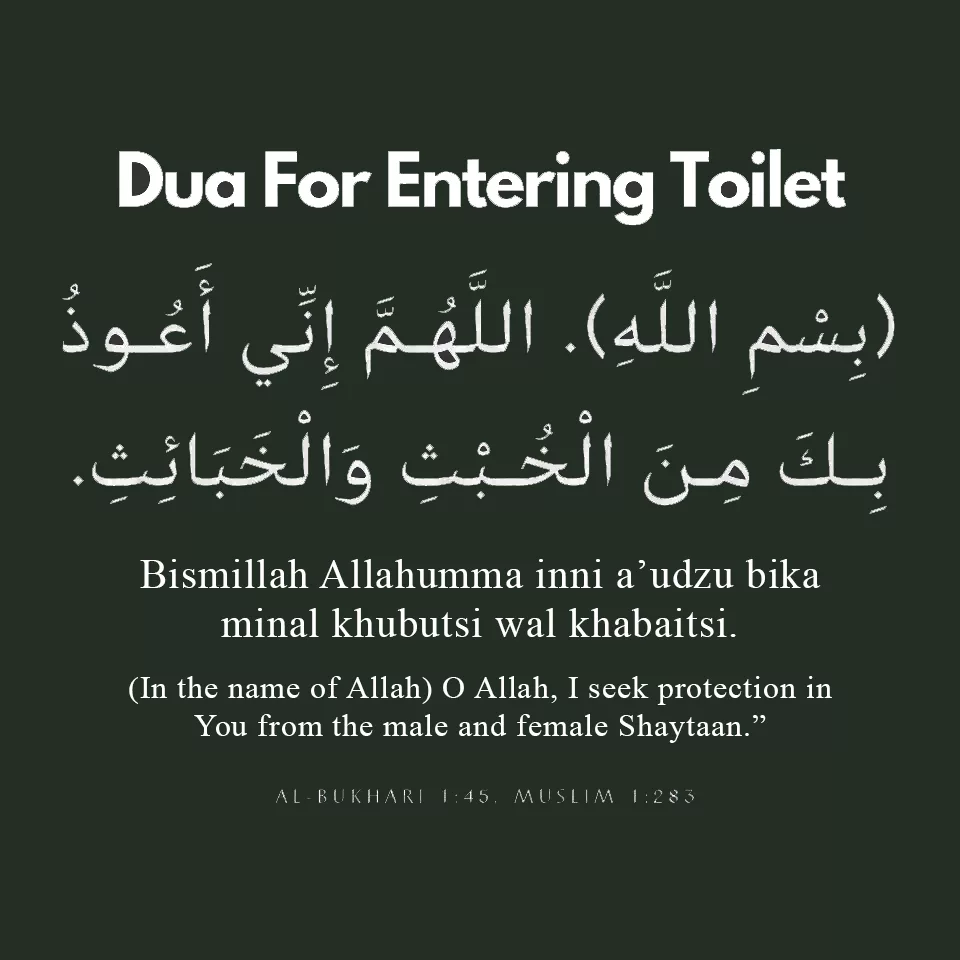
The opening word Bismillah (“in the name of Allah”) was added to the dua based on a hadith reported by Imam Tirmidhi: “The screen between the eyes of the jinn and the private parts of the children of Adam, when one of them enters the toilet, is to say Bismillah” (Jami’ at-Tirmidhi 606, classed hasan). Saying Bismillah first, then the rest of the dua, is the most complete form taught by the scholars of hadith.
Related:


Dua for Leaving the Bathroom (Arabic, Transliteration, Meaning)
غُفْرَانَكَ
Ghufranak
“(I seek) Your forgiveness, O Allah.”
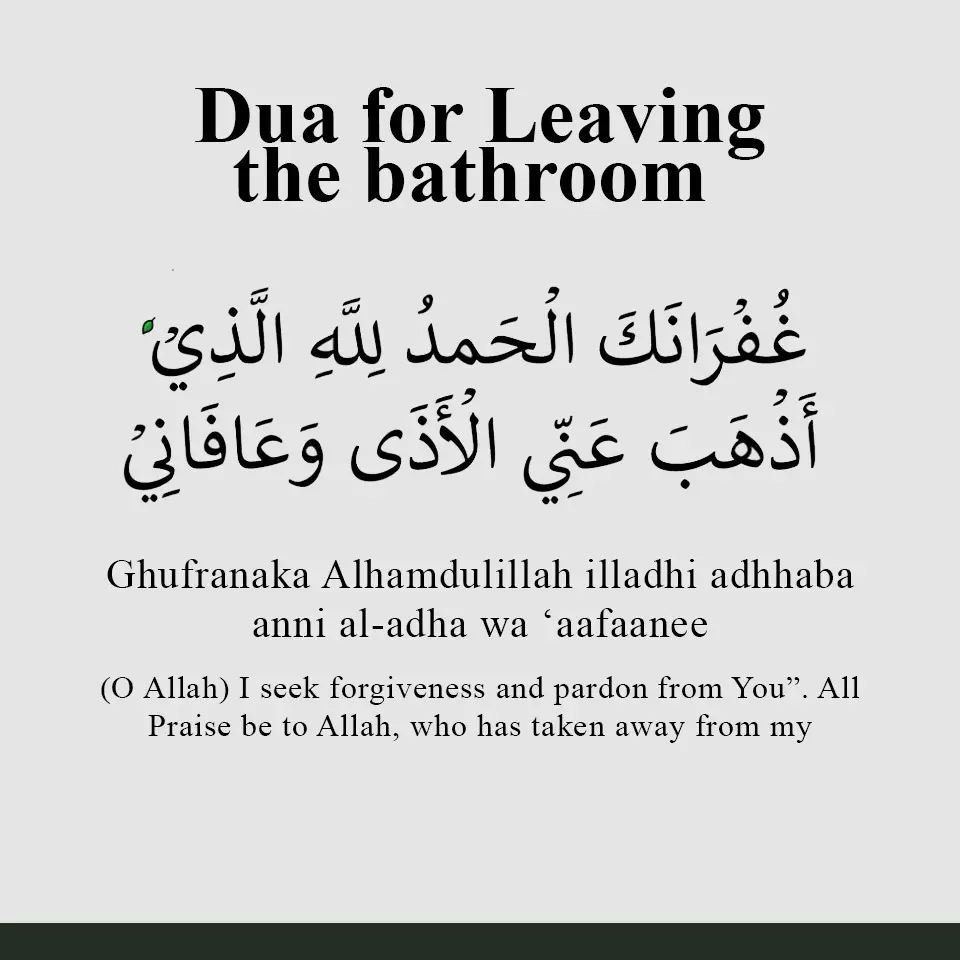
Aisha (may Allah be pleased with her) said that when the Prophet ﷺ left the toilet, he would say Ghufranak — “Your forgiveness” (Sunan Abi Dawud 30, Jami’ at-Tirmidhi 7, Sunan Ibn Majah 300 — classed sahih). Some scholars explain that the believer asks for forgiveness because they were unable to remember Allah while inside, and now that they have left the place of impurity, they ask Allah to overlook that interruption.
An additional supplication is reported in some traditions: Alhamdulillahi-lladhi adh-haba ‘annil-adha wa ‘afani — “Praise be to Allah who removed the harm from me and gave me well-being” (narrated by Ibn Majah 301, Ibn al-Sunni). Both wordings are valid; the most authentic and widespread among the scholars is the simple Ghufranak.
Left Foot In, Right Foot Out: The Sunnah Order
The Prophet ﷺ used the right side for everything honourable — eating, drinking, putting on shoes, entering the mosque — and the left side for the opposite. Aisha (may Allah be pleased with her) said: “The Prophet ﷺ used to like to start with the right side in putting on shoes, combing his hair, his purification, and in all his affairs” (Sahih al-Bukhari 168, Sahih Muslim 268).
From this principle, the scholars derived the bathroom rule:
- Entering the bathroom — step in with the left foot first, then say the dua of entry.
- Leaving the bathroom — step out with the right foot first, then say Ghufranak.
If the bathroom is also used as a place of wudu (ablution) without an enclosed toilet area, you can begin the dua before fully entering, since the prohibition on remembrance of Allah applies specifically to the area of impurity.
Islamic Toilet Etiquette (Adab) From the Hadith
- Cover yourself and stay private. The Prophet ﷺ would walk far away when relieving himself so no one could see him (Sunan Abi Dawud 2).
- Do not face or turn your back to the Qibla while relieving yourself in an open space (Sahih al-Bukhari 144, Sahih Muslim 264). Inside an enclosed bathroom most scholars permit it.
- Do not remember Allah aloud or carry anything with His name. The Prophet ﷺ removed his ring inscribed with “Muhammad Rasul Allah” before entering (Sunan Abi Dawud 19).
- Do not speak inside the toilet. The Prophet ﷺ once did not return the salam (greeting) of a man until after he had completed his ablution (Sahih Muslim 370).
- Do not urinate while standing when easier alternatives are available; the Sunnah is to sit (Jami’ at-Tirmidhi 12; though it is permitted with safeguards as the Prophet ﷺ did once — Sahih al-Bukhari 224).
- Do not urinate in stagnant water (Sahih al-Bukhari 239) or on a path used by people, or under a shade tree where they rest (Sunan Abi Dawud 26).
- Use the left hand for cleaning, and clean with water (istinja) using an odd number of stones if water is unavailable (Sahih Muslim 262).
- Wash your hands after, then perform wudu if you intend to pray.
How to Memorise Both Duas Today
- Step 1. Say “Bismillah” out of habit before any task — that is already the first half of the entry dua.
- Step 2. Add the second half: Allahumma inni a’udhu bika minal-khubuthi wal-khaba’ith. Repeat it ten times before bed for three nights.
- Step 3. Pair the act of stepping in with the left foot to the recitation. The physical cue locks the dua into memory.
- Step 4. For leaving, learn just one word: Ghufranak. It is the simplest dua in the Sunnah.
What is the dua for entering the bathroom?
The dua for entering the bathroom is: Bismillah, Allahumma inni a’udhu bika minal-khubuthi wal-khaba’ith — “In the name of Allah. O Allah, I seek refuge in You from male and female devils.” It is reported in Sahih al-Bukhari 142 and Sahih Muslim 375.
What is the dua for leaving the bathroom?
The dua for leaving the bathroom is the single word Ghufranak — “(I seek) Your forgiveness.” Aisha (RA) reported that the Prophet ﷺ would say this when leaving the toilet (Sunan Abi Dawud 30, Jami’ at-Tirmidhi 7).
Should I enter the bathroom with my left foot or right foot?
Enter the bathroom with the left foot first, and exit with the right foot first. This follows the Sunnah principle that the Prophet ﷺ used the right side for honourable actions and the left for places of impurity (Sahih al-Bukhari 168).
Can I say Bismillah inside the bathroom?
You should say Bismillah before entering the bathroom, not while inside. Once inside, the audible remembrance of Allah is paused out of respect. The opening Bismillah forms a screen of protection between the believer and the unseen, as taught in a hadith of Imam Tirmidhi (606).
What if I forget to say the dua before entering?
If you forget the dua of entry, simply say it silently in your heart as soon as you remember. There is no make-up requirement, but you can also recite Ghufranak when leaving as a form of seeking forgiveness for the lapse.
Can I take a phone with Quran or Allah’s name into the bathroom?
It is best to leave anything bearing Allah’s name or Quranic verses outside, following the Sunnah of the Prophet ﷺ who removed his engraved ring before entering the toilet (Sunan Abi Dawud 19). If a phone is needed, switch off any visible Quran app or screen-saver showing Allah’s name first.
Memorise both duas, train yourself to enter with the left foot and leave with the right, and let what was once a routine become a small, ongoing act of worship — protection on the way in, forgiveness on the way out.