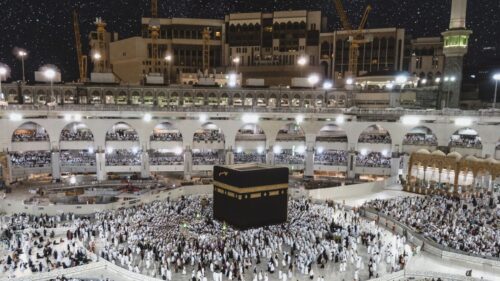


The 8 gates of Jannah are Bab as-Salah (Prayer), Bab al-Jihad (Striving), Bab as-Sadaqah (Charity), Bab ar-Rayyan (Fasting), Bab al-Hajj (Pilgrimage), Bab al-Kazimeen (the Forbearing), Bab al-Ayman (Right-Handed), and Bab adh-Dhikr (Remembrance). Each gate calls those who excelled in its specific deed, as recorded in Sahih al-Bukhari 1897 and Sahih Muslim 1027.
Table of Contents
Allah describes the moment in Surah Az-Zumar: “And those who feared their Lord will be driven to Paradise in groups until, when they reach it while its gates have been opened, its keepers will say, ‘Peace be upon you; you have become pure; so enter it to abide eternally therein'” (Quran 39:73). The believers do not arrive at a single door. They arrive at eight, each one calling out to a specific kind of soul.
This is the mercy hidden inside what Jannah is: a destination so vast that the deed you cherished most in this life becomes the very gate that welcomes you in the Hereafter. The Prophet Muhammad (peace be upon him) named these gates explicitly in Sahih al-Bukhari and Sahih Muslim. Below, you will find the eight gates by their authentic names, the hadith behind each one, and what to do today to be called from one of them, or from all of them at once.
The 8 Gates of Jannah at a Glance
The Prophet (peace be upon him) said that Paradise has eight gates, and each gate carries the name of a deed. The gates of Charity, Prayer, Jihad, and Ar-Rayyan are explicitly named in the hadith of Abu Hurayrah recorded by both Bukhari (1897) and Muslim (1027). The remaining gates, Hajj, the Forbearing, the Right-Handed, and Dhikr, are confirmed through other authentic narrations and the explanations of classical scholars such as Ibn Hajar al-Asqalani.
Allah also reminds us in Surah Ar-Ra’d that the angels themselves greet the dwellers of Paradise: “And the angels will enter upon them from every gate” (Quran 13:23-24). Eight gates of mercy, each tied to an action you can begin practicing this very day.
| Those who performed the pilgrimage | English Name | Arabic | Transliteration | Who Enters | Hadith Reference |
|---|---|---|---|---|---|
| 1 | Gate of Prayer | باب الصلاة | Bab as-Salah | Those constant in obligatory prayer | Bukhari 1897, Muslim 1027 (Sahih) |
| 2 | Gate of Striving | باب الجهاد | Bab al-Jihad | Those who strove in Allah’s cause | Bukhari 1897, Muslim 1027 (Sahih) |
| 3 | Gate of Charity | باب الصدقة | Bab as-Sadaqah | Those who gave generously | Bukhari 1897, Muslim 1027 (Sahih) |
| 4 | Gate of Ar-Rayyan | باب الريان | Bab ar-Rayyan | Those who fasted (none else may enter) | Bukhari 1896, Muslim 1152 (Sahih) |
| 5 | Gate of Hajj | باب الحج | Bab al-Hajj | Those who performed pilgrimage | Ibn Hajar, Fath al-Bari on Bukhari 1897 |
| 6 | Gate of the Forbearing | باب الكاظمين | Bab al-Kazimeen | Those who restrain anger and pardon | Bayhaqi, Shu’ab al-Iman; Quran 3:134 |
| 7 | Gate of the Right-Handed | باب الأيمن | Bab al-Ayman | The 70,000 who enter without reckoning | Bukhari 5705, 6541, Muslim 220 (Sahih) |
| 8 | Gate of Dhikr | باب الذكر | Bab adh-Dhikr | Those constant in remembrance of Allah | Bukhari 6407 (Sahih); classical scholarship |
1. Bab as-Salah: The Gate of Prayer
The Prophet (peace be upon him) said: “Whoever spends a pair of anything in the cause of Allah will be called from the gates of Paradise. Whoever was among the people of prayer will be called from the Gate of Prayer” (Sahih al-Bukhari 1897, Sahih Muslim 1027, graded Sahih).
This gate calls those whose lives revolved around the five daily prayers. They prayed on time, prayed in congregation when able, and guarded the sunnah and witr around their fard. Anyone serious about being summoned by Bab as-Salah today usually adds night prayer to their routine, because the angels still record nawafil long after most people are asleep. Pray your fard with khushu, and let the optional prayers carry your name to this gate.
2. Bab al-Jihad: The Gate of Striving
In the same hadith of Abu Hurayrah, the Prophet (peace be upon him) said: “Whoever was among the people of jihad will be called from the Gate of Jihad” (Sahih al-Bukhari 1897, Sahih Muslim 1027, graded Sahih). Bab al-Jihad welcomes those who exhausted themselves striving for the sake of Allah.
Classical scholars including Imam an-Nawawi explained jihad here as struggle in Allah’s path in its broadest authentic sense: defending the religion, struggling against the lower self (jihad an-nafs), and the patient effort of carrying truth in a world that resists it. The deed that earns this gate is the willingness to be inconvenienced for Allah, whether through sacrifice of wealth, time, or comfort, until your effort becomes worship.
3. Bab as-Sadaqah: The Gate of Charity
The Prophet (peace be upon him) continued: “Whoever was among the people of charity will be called from the Gate of Charity” (Sahih al-Bukhari 1897, Sahih Muslim 1027, graded Sahih). This gate is reserved for those whose hands stayed open, whether they had a lot or a little.
Related:


Charity in Islam is not measured purely in dirhams. The Prophet ﷺ taught that even removing harm from the road, smiling at your brother, and saying a kind word are sadaqah. Bab as-Sadaqah calls people whose default response to need was to give. Set up a small recurring sadaqah, even a single dollar a week, and pair it with spontaneous giving when you see someone struggling. Consistency is what the gate is named after.
4. Bab ar-Rayyan: The Gate of Fasting
The Prophet (peace be upon him) said: “In Paradise there is a gate called Ar-Rayyan, through which only those who used to fast will enter on the Day of Resurrection. None except them will enter through it. It will be said, ‘Where are those who used to fast?’ So they will get up, and none except them will enter through it. After they have entered, it will be closed, and no one else will enter through it” (Sahih al-Bukhari 1896, Sahih Muslim 1152, graded Sahih).
The name Ar-Rayyan literally means “the well-watered”, a quenching for those whose throats went dry for Allah’s sake. An estimated 1.8 billion Muslims observe the fast of Ramadan each year (Pew Research Center, 2025), and beyond fasting in Ramadan, the Prophet encouraged the optional fasts of Mondays, Thursdays, and the white days. Those small acts add up to a name being called at this exclusive gate.
5. Bab al-Hajj: The Gate of Pilgrimage
Although Bab al-Hajj is not named in the Bukhari 1897 narration alongside the four gates of Prayer, Jihad, Charity, and Fasting, classical scholars, including Ibn Hajar al-Asqalani in Fath al-Bari identified it as one of the eight gates corresponding to the pillars of Islam. Hajj is the fifth pillar, and the gate of Hajj welcomes those who answered Allah’s call to His sacred House.
The Prophet (peace be upon him) said an accepted Hajj has no reward except Paradise (Sahih al-Bukhari 1773). Even before you stand in Arafah, you can rehearse the heart of Hajj by learning the Talbiyah and reciting it during the days of Dhul-Hijjah. The pilgrim’s mindset, sincere submission and complete surrender, is the deed this gate honours.
6. Bab al-Kazimeen: The Gate of the Forbearing
This gate is named directly from the Quran. Allah praises “those who restrain anger and who pardon the people” (Quran 3:134), and the gate carries that exact phrase, Bab al-Kazimeen al-Ghaiz wa-al-Afina an an-Nas. It is mentioned in Imam al-Bayhaqi‘s Shu’ab al-Iman and supported by the broader Quranic context of mercy.
The deed at this gate is one of the rarest qualities a believer can carry: swallowing your anger when you have every right to release it, and choosing forgiveness when revenge is on the table. The Prophet (peace be upon him) said the strong person is not the wrestler, but the one who controls himself when angry (Sahih al-Bukhari 6114, Sahih Muslim 2609). Master that, and a gate opens.
7. Bab al-Ayman: The Gate of the Right-Handed
The Prophet (peace be upon him) said: “Seventy thousand of my Ummah will enter Paradise without reckoning. They are the ones who do not seek ruqyah, do not believe in evil omens, and rely upon their Lord” (Sahih al-Bukhari 5705, 6541, Sahih Muslim 220, graded Sahih). These are the people of Bab al-Ayman, the Gate of the Right-Handed.
Their hallmark is tawakkul, complete reliance on Allah without superstition, without hedging their faith with charms or omens, and without compromising on tawhid. The right hand in Islamic imagery is the side of the saved, the people whose books are placed in their right hands on the Day of Judgement. This gate honours those whose certainty in Allah was so quiet and so total that Paradise opens for them without a long account.
8. Bab adh-Dhikr: The Gate of Remembrance
The Prophet (peace be upon him) said: “The example of the one who remembers his Lord and the one who does not is like that of the living and the dead” (Sahih al-Bukhari 6407, graded Sahih). Bab adh-Dhikr is named for those whose tongues were never dry of the remembrance of Allah.
Classical scholars, including Ibn al-Qayyim in Hadi al-Arwah ila Bilad al-Afrah, identify Dhikr as the eighth gate (some narrations call it the Gate of Iman or Tawbah, see the next section). The deed is simple and lifelong: tasbih on your fingers, tahlil under your breath in traffic, istighfar between meetings, salawat upon the Prophet at red lights. The remembrance of Allah is the only worship without a dedicated time slot, which is exactly why it earns its own gate.
Can Anyone Enter Through All 8 Gates of Jannah?
Yes. In the famous hadith of Abu Hurayrah, after the Prophet (peace be upon him) listed those called from the Gates of Prayer, Jihad, Ar-Rayyan, and Charity, Abu Bakr as-Siddiq (may Allah be pleased with him) asked: “Will anyone be called from all of them, O Messenger of Allah?” The Prophet replied: “Yes, and I hope you will be among them, O Abu Bakr” (Sahih al-Bukhari 1897, Sahih Muslim 1027, graded Sahih).
The path Abu Bakr walked was excellence in every category, not perfection in just one. There are many ways to earn Jannah, and the simplest daily route to having all eight gates opened is the wudu hadith. The Prophet (peace be upon him) said: “Whoever performs wudu thoroughly and then says: ‘Ash-hadu an la ilaha illa Allah wa anna Muhammadan abduhu wa rasuluhu’, the eight gates of Paradise will be opened for him and he may enter through whichever of them he wishes” (Sahih Muslim 234, graded Sahih). A complete wudu, the shahadah at its end, and every gate is unlocked.
Are There 7 or 8 Gates of Jannah?
Jannah has eight gates and Jahannam has seven. The confusion usually comes from Surah Al-Hijr, where Allah describes Hell: “It has seven gates; for every gate is a portion designated” (Quran 15:44). That is Hell’s count. Paradise, by contrast, has eight, as confirmed in Sahih Muslim 234 and the Bukhari hadith of Abu Hurayrah. Classical scholars described this asymmetry as a sign of Allah’s mercy, eight gates of mercy outnumbering seven gates of wrath.
You will also see variations in how the eighth gate is named. Some narrations call it the Gate of Iman, some the Gate of Tawbah, and some the Gate of Dhikr. Ibn al-Qayyim in Hadi al-Arwah and the contemporary scholar Soubhi El-Saleh in his classification of eschatological narrations both note that these names point to overlapping spiritual realities, faith expressed through repentance and remembrance, rather than to a contradiction in the sources. The count of eight is firm; the eighth label varies by narration.
What are the 8 gates of Jannah?
The 8 gates of Jannah are Bab as-Salah (Prayer), Bab al-Jihad (Striving), Bab as-Sadaqah (Charity), Bab ar-Rayyan (Fasting), Bab al-Hajj (Pilgrimage), Bab al-Kazimeen (the Forbearing), Bab al-Ayman (Right-Handed), and Bab adh-Dhikr (Remembrance). Four are explicitly named in Sahih al-Bukhari 1897 and Sahih Muslim 1027; the others are confirmed in further authentic narrations and classical commentary such as Ibn Hajar’s Fath al-Bari.
Who enters through Bab Ar-Rayyan?
Only those who used to fast for the sake of Allah enter through Bab ar-Rayyan. The Prophet (peace be upon him) said it is reserved exclusively for them, and once they have entered, the gate will be closed and no one else may pass through (Sahih al-Bukhari 1896, Sahih Muslim 1152, graded Sahih). The name means the well-watered, a reward for throats that went dry in obedience.
Can a person enter Jannah through all 8 gates?
Yes. When Abu Bakr as-Siddiq asked the Prophet (peace be upon him) whether anyone would be called from all the gates, the Prophet answered: “Yes, and I hope you will be among them, O Abu Bakr” (Sahih al-Bukhari 1897, Sahih Muslim 1027). The everyday route is the wudu hadith of Sahih Muslim 234, where complete wudu followed by the shahadah opens all 8 gates.
Are there 7 or 8 gates of Jannah?
Jannah has 8 gates; Jahannam has 7. The confusion arises from Quran 15:44, which describes Hell as having seven gates. Paradise, by contrast, has eight, as confirmed in Sahih Muslim 234 and the hadith of Abu Hurayrah in Sahih al-Bukhari 1897. Classical scholars saw the asymmetry as a sign of Allah’s mercy outweighing His wrath: eight gates of mercy versus seven of punishment.
What is the highest level of Jannah?
The highest level of Paradise is Jannatul Firdaus. The Prophet (peace be upon him) said: “When you ask Allah for Paradise, ask Him for Firdaus, for it is the highest part of Paradise and from it spring forth the rivers of Paradise, and above it is the Throne of the Most Merciful” (Sahih al-Bukhari 7423, graded Sahih). It is the destination most worthy of being asked for in du’a.
What is the Gate of Dhikr?
Bab adh-Dhikr is the gate of those whose tongues remained moist with the remembrance of Allah throughout their lives. The Prophet (peace be upon him) compared the one who remembers his Lord to the living, and the one who neglects dhikr to the dead (Sahih al-Bukhari 6407). Some narrations name the eighth gate as the Gate of Iman or Tawbah; classical scholars see these as overlapping descriptions of the same gate.
A Closing Du’a for Jannah
The Prophet (peace be upon him) taught a short, complete supplication that asks Allah for Paradise and seeks refuge from the Fire: Allahumma inni as’aluka al-jannah, wa a’udhu bika min an-nar, “O Allah, I ask You for Paradise and seek refuge in You from the Fire.” Anas ibn Malik narrated that whoever asks Allah for Paradise three times, Paradise itself says, “O Allah, admit him into Paradise” (Sunan at-Tirmidhi 2572, Sunan an-Nasa’i, graded Sahih by al-Albani).
Make this the dua for Jannah a habit after every salah, and pair it with one small deed from each of the eight gates: a sunnah prayer, a coin in charity, a voluntary fast, a remembered Talbiyah, a swallowed insult, a moment of dhikr. Eight gates. Eight invitations. May Allah open the one that calls your name, and may He place you among those greeted with peace.