


The Prophet ﷺ taught a short dua before eating and a longer dua after eating — both turn an ordinary meal into a moment of remembrance and gratitude. This guide gives you the Arabic, transliteration, and English meaning of each dua, the hadith sources behind them, what to say if you forget the opening Bismillah, and the full Sunnah etiquette of eating that the Prophet ﷺ taught.
The duas are short enough to memorise in one sitting. The benefit is large: the Prophet ﷺ explained that when a Muslim says Bismillah, the food is protected, and saying Alhamdulillah at the end is one of the most pleasing forms of praise to Allah.
Table of Contents
Dua Before Eating: Bismillah
بِسْمِ اللَّهِ
Bismillah
“In the name of Allah.”
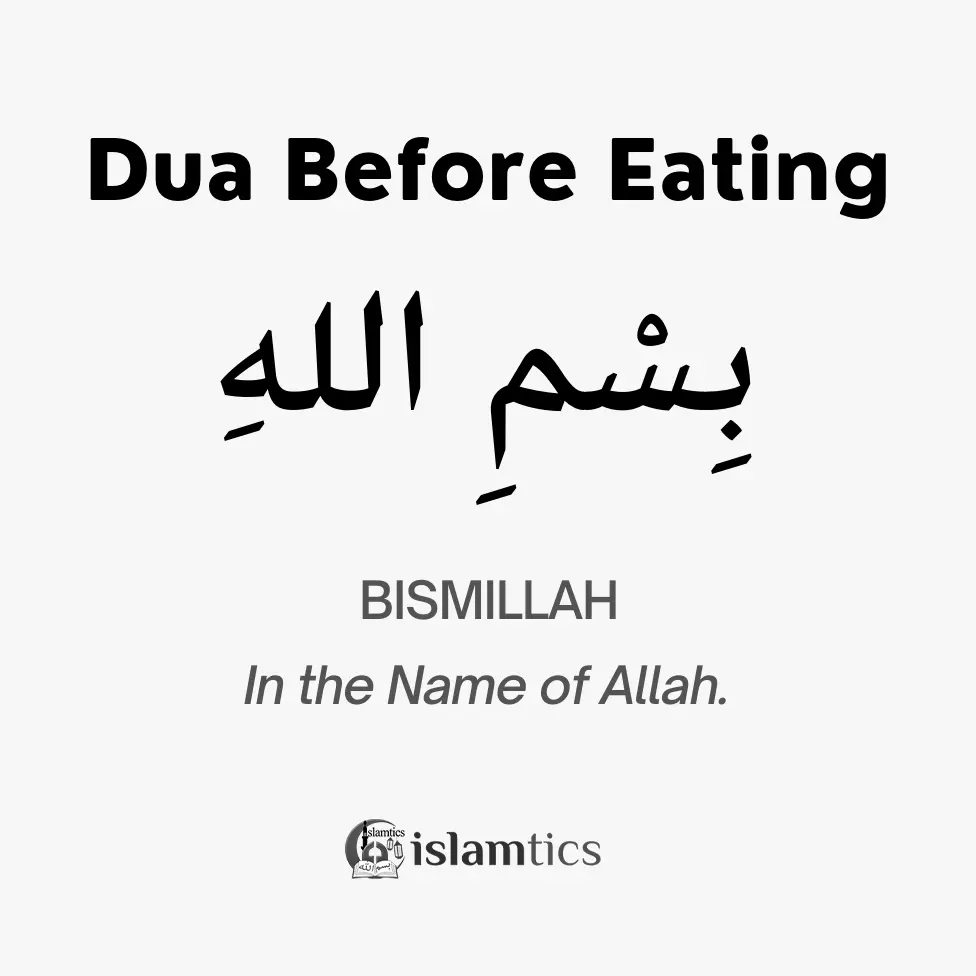
Umar ibn Abi Salamah (may Allah be pleased with him) said: “I was a young boy under the care of the Messenger of Allah ﷺ, and my hand used to wander about in the dish. So the Messenger of Allah ﷺ said to me: ‘O young boy, mention the name of Allah, eat with your right hand, and eat from what is near you‘” (Sahih al-Bukhari 5376, Sahih Muslim 2022). This single hadith gives us three rules at once — say Bismillah, eat with the right hand, and take from the side of the plate closest to you.
Saying Bismillah protects the food from being shared with Shaytan. The Prophet ﷺ said: “Shaytan finds it lawful to eat the food on which the name of Allah has not been mentioned” (Sahih Muslim 2017). In another narration, the Prophet ﷺ described how Shaytan vomited what he had eaten when a person who had forgotten finally said the name of Allah at the end (Sunan Abi Dawud 3766).
Key takeaways:
- Saying Bismillah before eating protects the food from Shaytan — “Shaytan finds it lawful to eat the food on which the name of Allah has not been mentioned” (Sahih Muslim 2017).
- If you forget Bismillah, say “Bismillahi awwalahu wa akhirahu” (بِسْمِ اللهِ أَوَّلَهُ وَآخِرَهُ) — “In the name of Allah, at its beginning and at its end” (Sunan Abi Dawud 3767).
- Three Sunnah etiquettes the Prophet ﷺ taught a young Umar ibn Abi Salamah in one short hadith: mention Allah’s name, eat with the right hand, and eat from what is near you (Sahih al-Bukhari 5376).
- A longer dua after eating earns more reward: “Alhamdulillahil-ladhi at’amana hadha wa razaqani-hi min ghayri hawlin minni wa la quwwah” — “All praise is for Allah who fed me this and provided it without any might or power on my part” (Jami’ at-Tirmidhi 3458).
What to Say If You Forget Bismillah
بِسْمِ اللَّهِ أَوَّلَهُ وَآخِرَهُ
Bismillahi awwalahu wa akhirahu
Related:


“In the name of Allah, at its beginning and its end.”
Aisha (may Allah be pleased with her) reported that the Prophet ﷺ said: “When one of you eats, let him mention the name of Allah. If he forgets to mention the name of Allah at the beginning, let him say Bismillahi awwalahu wa akhirahu” (Sunan Abi Dawud 3767, Jami’ at-Tirmidhi 1858 — classed sahih). This phrase covers the meal retroactively, so even if Shaytan had begun to eat with you, the protection of Allah’s name now applies to the whole sitting.
Dua After Eating: Alhamdulillah
الْحَمْدُ لِلَّهِ الَّذِي أَطْعَمَنَا وَسَقَانَا وَجَعَلَنَا مُسْلِمِينَ
Alhamdu lillahil-ladhi at’amana wa saqana wa ja’alana muslimeen
“All praise is for Allah who fed us, gave us drink, and made us Muslims.”
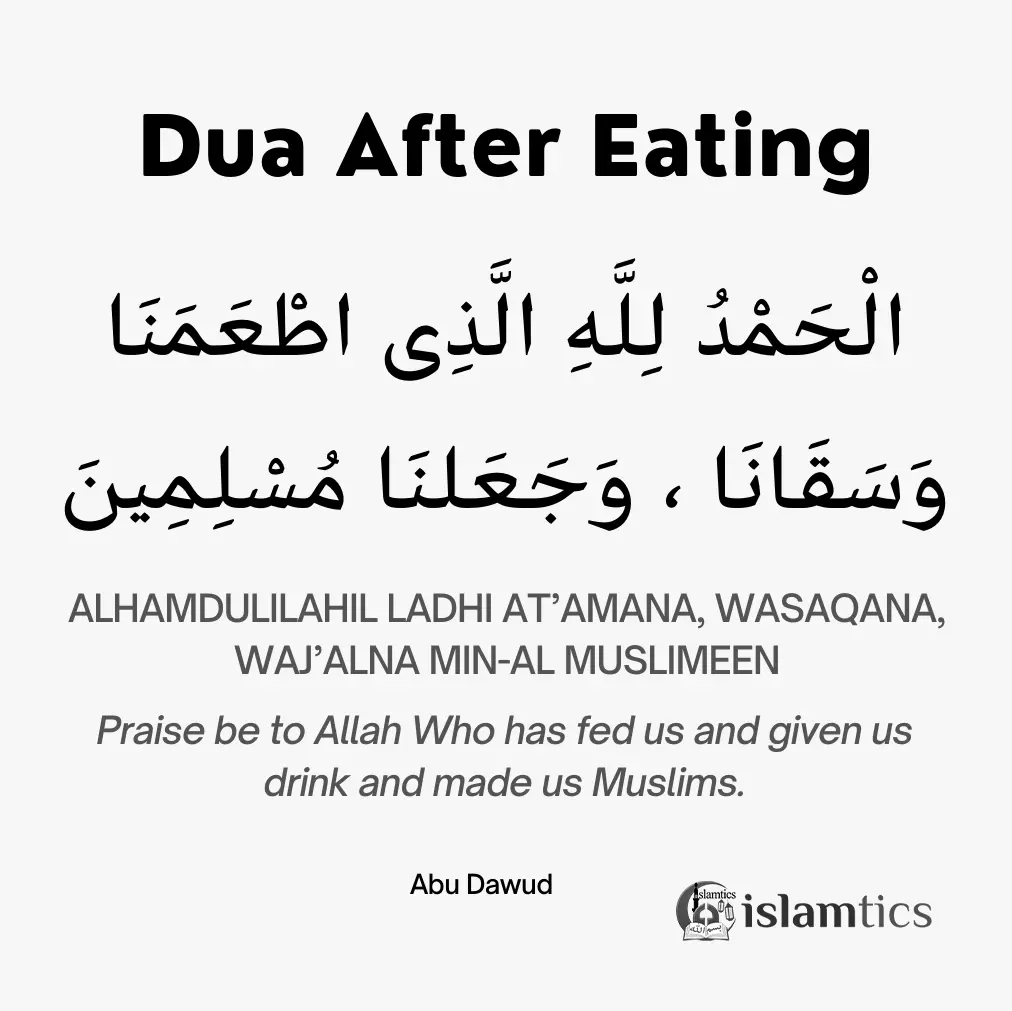
Abu Sa’id al-Khudri (may Allah be pleased with him) reported that whenever the Prophet ﷺ finished eating, he would say this exact dua (Sunan Abi Dawud 3850, Jami’ at-Tirmidhi 3457 — classed sahih by al-Albani). The dua thanks Allah for three things in one sentence: the food, the drink, and the gift of Islam — three blessings most people receive every single day.
A Longer Dua After Eating (For More Reward)
الْحَمْدُ لِلَّهِ حَمْدًا كَثِيرًا طَيِّبًا مُبَارَكًا فِيهِ، غَيْرَ مَكْفِيٍّ وَلَا مُوَدَّعٍ وَلَا مُسْتَغْنًى عَنْهُ، رَبَّنَا
Alhamdu lillahi hamdan kathiran tayyiban mubarakan fih, ghayra makfiyyin wa la muwadda’in wa la mustaghnan ‘anhu, Rabbana
“All praise is for Allah, abundant, pure, and blessed praise; praise that is never sufficient, never bid farewell, and never dispensed with. Our Lord.”
Abu Umamah (may Allah be pleased with him) reported that whenever the Prophet ﷺ finished his meal he would say this longer dua (Sahih al-Bukhari 5458). It is one of the most comprehensive forms of praising Allah after a meal — perfect for moments when you want to extend your gratitude beyond the short Alhamdulillah.
Dua to Make for the Host (When Eating at Someone’s Home)
اللَّهُمَّ بَارِكْ لَهُمْ فِيمَا رَزَقْتَهُمْ، وَاغْفِرْ لَهُمْ وَارْحَمْهُمْ
Allahumma barik lahum fima razaqtahum, waghfir lahum warhamhum
“O Allah, bless them in what You have provided for them, forgive them, and have mercy on them.”
Abdullah ibn Bisr (may Allah be pleased with him) said the Prophet ﷺ visited his father, who served him food. After eating, the Prophet ﷺ said this dua for the family (Sahih Muslim 2042). Whenever someone hosts you for a meal, this is the prophetic gift you leave with them.
Sunnah Etiquette of Eating
- Wash your hands before and after. The Prophet ﷺ said: “The blessing of food is in washing the hands before and after it” (Jami’ at-Tirmidhi 1846).
- Say Bismillah out loud at the start so others around you remember too (Sahih al-Bukhari 5376).
- Eat with the right hand. The Prophet ﷺ said: “Let none of you eat with his left hand or drink with his left hand, for Shaytan eats with his left hand and drinks with his left hand” (Sahih Muslim 2020).
- Eat from what is in front of you on the plate, not the middle or the far side (Sahih al-Bukhari 5376).
- Do not criticise food. The Prophet ﷺ never criticised any food: if he liked it he ate it, and if he disliked it, he simply left it (Sahih al-Bukhari 5409, Sahih Muslim 2064).
- Do not eat reclining. The Prophet ﷺ said: “I do not eat while reclining” (Sahih al-Bukhari 5398).
- Do not blow on hot food or breathe into the drinking vessel (Jami’ at-Tirmidhi 1888 — hasan).
- Lick the fingers and the plate clean. The Prophet ﷺ taught that you do not know in which part of your food the blessing is (Sahih Muslim 2034).
- Eat together. The Prophet ﷺ said: “Eat together and not separately, for the blessing is associated with the company” (Sunan Ibn Majah 3287 — hasan).
- End with Alhamdulillah. The Prophet ﷺ said: “Allah is pleased with His servant who praises Him when he eats and praises Him when he drinks” (Sahih Muslim 2734).
What is the dua before eating in Islam?
The dua before eating is simply Bismillah — “In the name of Allah.” The Prophet ﷺ taught: “When any of you wants to eat, let him say Bismillah” (Sahih al-Bukhari 5376). Saying Bismillah protects the meal from Shaytan, who otherwise eats with the person.
What is the dua after eating?
The most common dua after eating is: Alhamdu lillahil-ladhi at’amana wa saqana wa ja’alana muslimeen — “All praise is for Allah who fed us, gave us drink, and made us Muslims” (Sunan Abi Dawud 3850, Jami’ at-Tirmidhi 3457).
What if I forget to say Bismillah before eating?
If you forget Bismillah at the start, say Bismillahi awwalahu wa akhirahu — “In the name of Allah, at its beginning and its end” (Sunan Abi Dawud 3767, Jami’ at-Tirmidhi 1858). This covers the entire meal retroactively, even if Shaytan had begun to eat with you.
Can I say a longer dua before eating?
Bismillah on its own is the Sunnah. Some people add the full Bismillahir-Rahmanir-Raheem, which is also acceptable, but the shorter form is what the Prophet ﷺ explicitly taught for meals (Sahih al-Bukhari 5376).
What dua should I make for the person who fed me?
Say: Allahumma barik lahum fima razaqtahum, waghfir lahum warhamhum — “O Allah, bless them in what You have provided for them, forgive them, and have mercy on them” (Sahih Muslim 2042). The Prophet ﷺ said this for a family that hosted him.
Should I eat with my right hand or left hand?
Eat with the right hand. The Prophet ﷺ said: “Let none of you eat with his left hand or drink with his left hand, for Shaytan eats with his left hand and drinks with his left hand” (Sahih Muslim 2020). Using the left hand for eating contradicts a clear Sunnah.
Memorise the four-word Bismillah and the short Alhamdulillah, learn the back-up phrase for when you forget, and let every meal — from a snack to a feast — become a quiet act of worship that takes only a few seconds to complete.