

Reading Surah Al-Kahf on Friday is one of the most consistently recommended Sunnah practices in the weekly life of a Muslim. The Prophet Muhammad (peace and blessings be upon him) promised specific, named rewards for whoever recites this 110-verse Makki surah during the 24 hours of Jumu’ah — rewards that range from a divine light shining for the believer between the two Fridays to memorizing its opening verses as a shield against the Dajjal.
Yet many English-speaking Muslims have unanswered questions about this practice. Which exact hadith are sahih, and which are weak? Does the time window start at Thursday Maghrib or Friday Fajr? Can the surah be split into segments across the day? Does listening count if you cannot read Arabic? This guide answers each of these from primary sources — with grades, fatwa numbers, and a practical Friday routine you can keep.
Why Surah Al-Kahf Is Recited Every Friday
Friday (Yawm al-Jumu’ah) is the most virtuous day of the week in Islam. The Prophet (ﷺ) said it is the day on which Adam was created, the day he was admitted to Paradise, and the day he was sent down to earth — and the Hour will not be established except on a Friday (Sahih Muslim 854). For a fuller treatment of the day’s significance, see our piece on the meaning of Jumma Mubarak and 5 significances of Friday.
Surah Al-Kahf (“The Cave”) is the 18th chapter of the Quran, with 110 verses revealed in Makkah before the Hijrah. It is the 68th surah by order of revelation and spans Juz’ 15 and 16 in the mushaf. Read the full Arabic and English text at Surah Al-Kahf (Chapter 18).
The surah was revealed in response to three test-questions Quraysh polytheists posed to the Prophet (ﷺ) after consulting the People of the Book: the story of the People of the Cave, the identity of al-Khidr, and the account of Dhul-Qarnayn. Each is answered within the chapter. That historical context is part of why scholars later connected the surah to a weekly — not occasional — reading. The four narratives it contains are not random; they form a tightly themed defence against the four trials the Prophet (ﷺ) warned would arise at the end of time.
Key takeaways:
- Reading Surah Al-Kahf on Friday is a Sunnah with at least four authenticated hadith, the strongest being Mishkat 2175 (graded hasan by al-Albani).
- The window runs from Thursday sunset to Friday sunset, because the Islamic day begins at Maghrib (IslamQA #10700).
- Memorizing the first ten verses — or, by an alternate chain in Sahih Muslim, the last ten — protects the believer from the Dajjal.
- Splitting the recitation across multiple sittings is permitted; completing it in one go is preferable (Islamweb fatwa #442510).
- Those who cannot read Arabic may listen with the intention of seeking the reward and, by the scholars’ mercy, are hoped to receive it.
Authentic Hadith on Surah Al-Kahf and Friday (with Grades)
Four hadith are commonly cited for the Friday recitation. Naming the collection, the hadith number, and the grader matters — especially for religious content — because not every narration about this surah is equally authenticated.
1. The light between the two Fridays
The Prophet (ﷺ) said: “If anyone recites Surah al-Kahf on Friday, light will shine brightly for him till the next Friday.”
Narrator: Abu Sa’id al-Khudri (RA). Collections: al-Bayhaqi in al-Da’awat al-Kabir, al-Hakim in al-Mustadrak, Sunan al-Darimi 3312, and recorded in Mishkat al-Masabih 2175 (Book 8, Hadith 65). Grade: hasan by al-Albani; classed sahih in Sahih al-Jami’ #6470. Ibn Hajar stated in Takhrij al-Adhkar that this is the strongest report narrated concerning reading Surah Al-Kahf. Source: sunnah.com/mishkat:2175.
2. The light from feet to the clouds — with forgiveness
The longer narration adds two elements not present in the first: light extending from beneath the believer’s feet up to the clouds of the sky, and forgiveness of sins between the two Fridays. Narrated from Ibn Umar (RA), recorded by Abu Bakr ibn Mardawayh in his Tafsir and al-Hakim in al-Mustadrak. Classed sahih by al-Albani through the combined chains.
Related:


3. The light to the Ancient House (night-of-Jumu’ah variant)
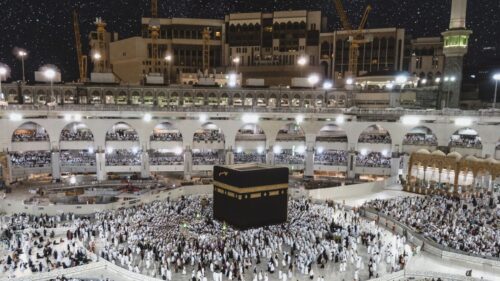
“Whoever reads Surat al-Kahf on the night of Jumu’ah, a light will shine for him which extends from him to the Ancient House (the Ka’bah).” Narrated from Abu Sa’id al-Khudri (RA), recorded in Sunan al-Darimi 3312, al-Bayhaqi 5856, and Sahih al-Targhib wa al-Tarhib #736. Graded sahih by al-Albani in Sahih al-Jami’ #6471. This is the basis for scholars who include Thursday night within the valid window. Source: sunnah.com/virtues:37.
4. The Dajjal-protection hadith
“If anyone learns by heart the first ten verses of Surah al-Kahf, he will be protected from the Dajjal.” Narrated from Abu al-Darda’ (RA) in Sahih Muslim 809a (Book 6, Hadith 311). This is sahih by consensus — covered in detail in the next section. Source: sunnah.com/muslim:809a.
Protection From the Dajjal: The First Ten Verses (and the Last Ten)
The most concrete promise attached to Surah Al-Kahf is protection from the false messiah, the Dajjal — whose appearance the Prophet (ﷺ) described as the greatest trial humanity will face before the Day of Judgement. Memorizing ten specific verses is the named shield.
What many English-language guides miss is that Sahih Muslim transmits two versions of this hadith. In the chain narrated by Shu’ba (Muslim 809b), the wording is “the last ten verses of Surah al-Kahf.” In the chain narrated by Hammam (Muslim 809a), the wording is “the first ten verses.” Both chains are in Sahih Muslim. Source: sunnah.com/muslim:809a and sunnah.com/muslim:809b.
The scholarly recommendation that follows from this variation is straightforward: memorize both passages. Several contemporary scholars cite this approach — including the response on IslamQA Hanafi #122747 — treating both ten-verse blocks as worthy of memorization. The opening verses establish the absolute oneness of Allah and warn against polytheism; the closing verses describe Dhul-Qarnayn’s barrier against Ya’juj and Ma’juj and end with a warning against shirk — thematically two anchors against the Dajjal’s central deception.
For context, the Prophet (ﷺ) said the Dajjal would appear with what looks like a paradise and a hellfire and would tempt people with wealth, sustenance, and seeming miracles. The believer who reads Surah Al-Kahf weekly and has its anti-fitna content woven into memory is rehearsed for that test. For more on protecting recitations across the week, see our piece on the 4 Quls — the protecting surahs.
The 4 Stories in Surah Al-Kahf and the 4 Trials They Teach
One of the most striking features of Surah Al-Kahf is that it groups four self-contained narratives, each addressing a distinct kind of trial (fitnah) that human beings face. Scholars of tafsir — with the framework popularized in modern times by Sh. Muhammad Salih al-Munajjid — map these to the four categories of trial the Dajjal will deploy: trials of religion, wealth, knowledge, and power.
Story 1 — The People of the Cave (verses 9–26): fitnah of religion
Young men who refused to abandon tawhid in a society hostile to monotheism fled to a cave, where Allah caused them to sleep for centuries. The lesson: when one’s faith is threatened, the way out is sincere trust in Allah, distance from the source of fitnah, and patience. The Dajjal’s first weapon is religious deception; this story prepares the believer to choose Allah over comfort.
Story 2 — The Owner of the Two Gardens (verses 32–44): fitnah of wealth
A man boasted of his orchards to a believing companion and forgot that everything he owned was a gift, not an achievement. His gardens were destroyed overnight. The lesson: wealth is a test, not a sign of divine favour, and gratitude protects what arrogance dismantles. The Dajjal will tempt with sudden riches; this story teaches the believer to see through them.
Story 3 — Musa and al-Khidr (verses 60–82): fitnah of knowledge
The Prophet Musa (AS) travelled to learn from al-Khidr and witnessed three actions that defied his moral judgement — each one having a hidden wisdom Musa could not yet see. The lesson: human knowledge has limits, and intellectual humility is a form of worship. The Dajjal will arrive claiming divine insight; this story reminds the believer that even a prophet bowed to what he could not understand.
Story 4 — Dhul-Qarnayn (verses 83–98): fitnah of power
A righteous king who governed from east to west used his authority to build a barrier against Ya’juj and Ma’juj — then credited the entire feat to Allah’s mercy, not his own strength. The lesson: power is for service, not self-glorification. The Dajjal will offer dominion to those who follow him; this story teaches that true authority returns the praise upward.
When to Read Surah Al-Kahf: The Time Window
The valid recitation window for the Friday Sunnah runs from Maghrib on Thursday to Maghrib on Friday — a full 24-hour Islamic-calendar day. The Islamic day begins at sunset, not midnight, which is why the “night of Jumu’ah” in the hadith refers to Thursday night, not Friday night.
Some narrations specify “the day of Jumu’ah” and others “the night of Jumu’ah.” Al-Manawi reconciles them by treating the full 24 hours as valid — this is the position adopted by Sh. Muhammad Salih al-Munajjid on IslamQA #10700. Source: islamqa.info/en/answers/10700.
Within that window, scholars including Sh. Yusuf Badat have noted that earlier is preferable — ideally Friday morning, on the principle of “hastening to good and not delaying acts of worship lest something prevent them.” If your Friday mornings are dense with work or school, Thursday evening after Maghrib is fully valid and removes the risk of forgetting altogether.
Can You Split the Recitation? Listening vs Reading?
Two questions account for most of the doubt that keeps people from being consistent: can the surah be split across the day, and does listening replace reading? Both have direct fatwa answers.
Splitting the recitation across sittings
Yes — you may split it. Islamweb fatwa #442510 states: “The apparent meaning of the ahadith does not require reciting the entire surah at once; rather, if one recites it during different parts of the day, then he has achieved what is commanded.” An-Nawawi held the same view regarding dhikr counts that may be distributed through the day. Completing it in one sitting is preferable, but a split recitation across morning, midday, and afternoon is valid. Source: islamweb.net fatwa #442510.
Listening instead of reading
The default ruling, as detailed in IslamQA #197900 by Sh. al-Munajjid, is that the named reward is for reciting — not merely listening. However, the same fatwa makes an explicit exception: a person who cannot read the Quran well, and who listens with the intention of seeking this reward, “there is hope he will have the same reward… because of his good intention and doing what he is able to do.” Source: islamqa.info/en/answers/197900.
Practical guidance for non-Arabic-speaking Muslims: read the Arabic transliteration if you cannot read the script, listen to a reciter while following along in Arabic, and read the English meaning afterwards for understanding. The reward is attached to the Arabic recitation — translation is tafsir, not Quran itself.
A Simple Friday Routine to Never Miss Surah Al-Kahf
The hardest part of any weekly Sunnah is consistency, not the act itself. A six-step routine pinned to existing prayers turns the recitation into a habit that does not depend on remembering on Friday morning.
- Thursday Maghrib — set the intention. Right after the sunset prayer, the Islamic day of Jumu’ah has begun. Open the mushaf or recitation app and read at least the first ten verses while the intention is fresh.
- Thursday night — complete a segment. Read verses 1–50 (roughly half the surah) before sleep. This is the window the Ancient House hadith references.
- Friday Fajr — resume after prayer. Read verses 51–82, which include the Musa and al-Khidr narrative. Pair with the recommended ghusl and clean clothing for Jumu’ah.
- Before Jumu’ah prayer — finish the surah. Read verses 83–110, including Dhul-Qarnayn and the closing warning against shirk.
- During Jumu’ah khutbah — listen attentively. Speaking during the khutbah nullifies the day’s rewards; silence is its own act of worship.
- Friday afternoon — pair with related Sunan. Make abundant salawat on the Prophet (ﷺ) and combine with the duas in our Friday duas and Jumma Mubarak supplications collection. The hour of acceptance falls somewhere between Asr and Maghrib.
This schedule satisfies the split-recitation fatwa, removes the all-at-once burden, and guarantees the surah is completed before Friday Maghrib closes the window. Within four to six weeks of practice, the routine becomes automatic.
Frequently Asked Questions
What is the best time to read Surah Al-Kahf on Friday?
The valid window runs from Maghrib on Thursday to Maghrib on Friday, because the Islamic day begins at sunset. Within that window, scholars including Sh. al-Munajjid (IslamQA #10700) recommend earlier rather than later — ideally Friday morning — on the principle of hastening to good and avoiding the risk of forgetting.
Can I read Surah Al-Kahf in parts throughout the day?
Yes. Islamweb fatwa #442510 explicitly permits splitting the recitation across different parts of the day, on the same basis an-Nawawi applied to distributed dhikr. Completing the surah in one sitting is preferable, but a morning-midday-afternoon split is valid and earns the named reward.
Is it enough to read only the first ten verses of Surah Al-Kahf?
The first-ten-verses hadith (Sahih Muslim 809a) attaches a specific reward — protection from the Dajjal — to memorizing them. The light-between-two-Fridays reward (Mishkat 2175) is tied to reading the full surah. The two rewards are distinct; reading the first ten only secures the Dajjal-protection promise but not the weekly light.
Can I listen to Surah Al-Kahf instead of reading it on Friday?
The default ruling per IslamQA #197900 is that listening does not earn the same reward as reciting. The exception, in the same fatwa: a person unable to read Quran well, who listens with the intention of seeking the reward, is hoped to receive it through Allah’s mercy for sincere intention and effort within their capacity.
What if I miss reading Surah Al-Kahf on Friday — is it a sin?
No. The Friday recitation is a Sunnah, not an obligation — missing it does not incur sin, but it forfeits that week’s named reward. There is no make-up recitation outside the Maghrib-to-Maghrib window; the believer simply intends to resume the following Friday with renewed commitment.
Can women read Surah Al-Kahf during menstruation?
Scholarly opinions differ. The Hanafi position discourages recitation; other schools permit it without touching the mushaf directly. Sh. Assim al-Hakeem explicitly advises women not to abandon their Surah Al-Kahf habit during menstruation. Listening to a recitation is universally permitted across all four madhhabs.
Why is Surah Al-Kahf specifically connected to the Dajjal?
Beyond the explicit Sahih Muslim 809 hadith on its protective verses, the surah’s four stories address the four kinds of fitnah the Dajjal will use: religion, wealth, knowledge, and power. Weekly engagement with these narratives rehearses the believer’s defences against the trials the Prophet (ﷺ) warned would be greatest at the end of time.
Can I read Surah Al-Kahf in English translation and get the same reward?
The named reward attaches to recitation of the Arabic text, since translation is tafsir, not the Quran itself. Non-Arabic speakers should read the Arabic transliteration where possible, listen to a reciter while following the script, and read the English meaning separately for understanding. Sincere effort within capacity is the principle the scholars repeatedly emphasize.
Start this Friday. Open Surah Al-Kahf in Arabic and English after Thursday Maghrib, read what you can before sleep, and finish the chapter before Friday’s sunset. Within a few weeks the routine will hold itself together — and the rewards the Prophet (ﷺ) promised are not abstract: they are a light between the two Fridays, the forgiveness of sins, and a shield against the greatest trial of the end of time.