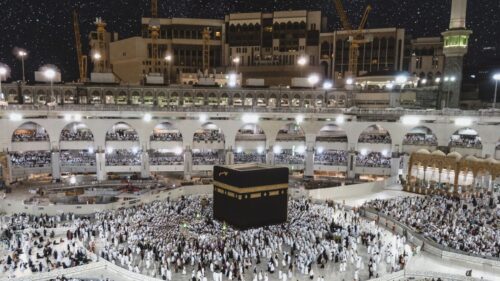

The Kaaba is Islam’s holiest site — a cube-shaped building at the centre of Masjid al-Haram in Makkah that every Muslim faces during prayer five times a day. But what is actually inside it? What is the golden door made of, who guards the keys, what is the Kiswa, and what is the small wall called the Hateem? Almost no one will see the interior in person. Only a handful of dignitaries enter each year, and only at the scheduled cleaning ceremony.
This guide pulls together what is reliably documented about the Kaaba’s interior, its door, its black silk Kiswa, the crescent-shaped Hijr Ismail beside it, and the famous Year of the Elephant when Allah protected the House — based on Saudi General Presidency archives, photographs taken during the annual washing ceremony, the hadith corpus, and accounts from those permitted inside.
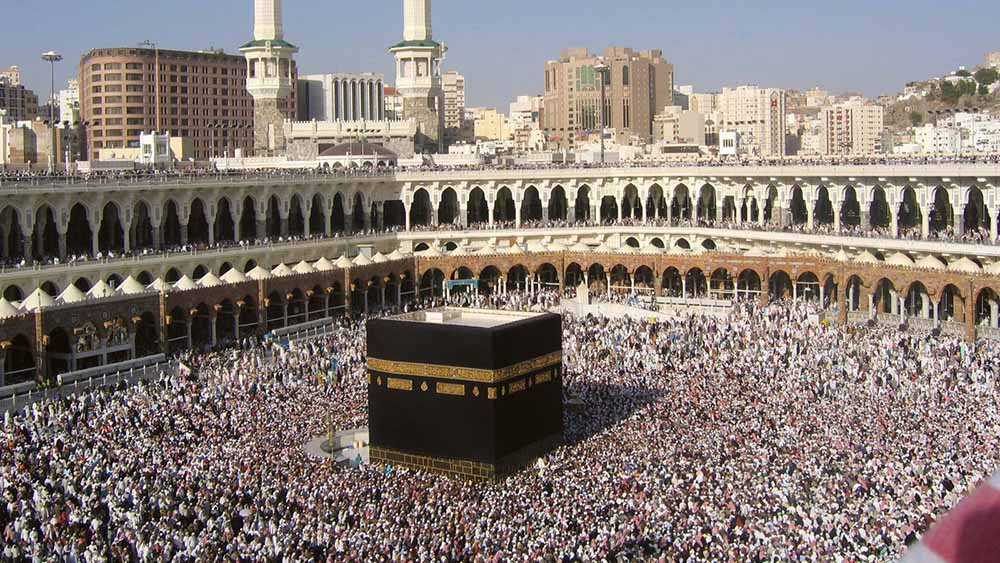
Table of Contents
A Quick Look at the Kaaba From the Outside
Before we go inside, here are the basic dimensions that orient everything else:
- Shape: roughly cubic — about 13.1 m tall, 11.03 m wide on the longer sides, 12.86 m on the shorter sides.
- Material: Makkan granite blocks, plastered and covered with the black silk Kiswa embroidered in gold.
- Door: a single elevated entry on the eastern wall, about 2.13 m above ground, made of pure gold weighing 280 kg, installed in 1979.
- Foundation: built originally by Prophet Ibrahim and his son Isma’il (Quran 2:127). The current structure follows the Quraysh-era reconstruction the Prophet ﷺ knew.
- Adjacent: a low semicircular wall on the north-west side called the Hijr Ismail or Hateem — historically part of the Kaaba’s footprint.

The dua Ibrahim and Isma’il said while raising the foundations — Rabbana Taqabbal Minna — is still recited by Muslims today after every act of worship.
The Golden Door of the Kaaba
The current door of the Kaaba was installed in Dhu al-Qi’dah 1399H (October 1979) on the order of King Khalid bin Abdul Aziz, after the previous silver door — installed in 1942 — had begun to show wear. It is the most photographed feature of the building and arguably the most valuable single religious door in the world.
- Material: 280 kg of pure gold (estimated value ~$12 million).
- Dimensions: 310 cm tall, 170 cm wide, 50 cm thick.
- Position: raised about 2.13 m above ground level on the eastern wall.
- Time to make: roughly 12 months, with about 3 months on design alone.
- Engineering: built to withstand Makkah’s extreme heat and to keep rainwater out of the interior.
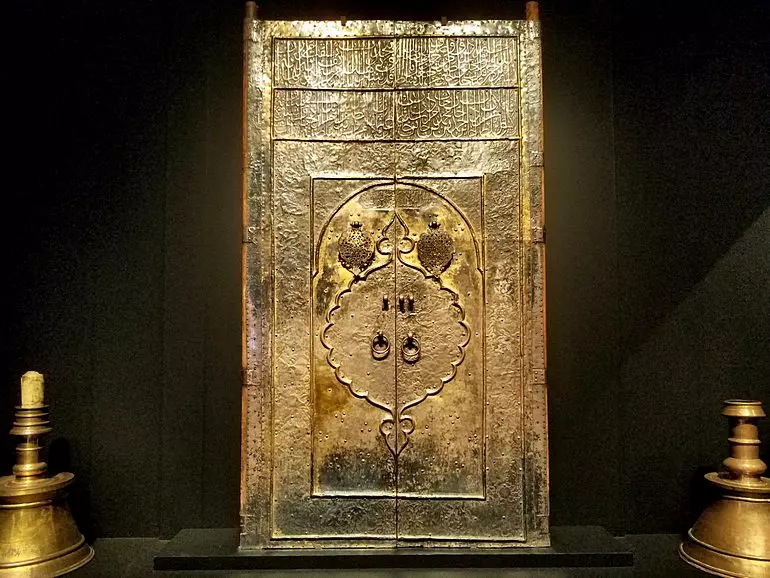
The Kaaba did not always have a door. According to early historians, the Kaaba was originally open and any visitor could walk in. The first recorded door was commissioned by Tubba’ the Third, a king of Yemen, long before the birth of the Prophet Muhammad ﷺ. Over the next thirteen centuries, the door’s material and design were updated by successive caliphs, sultans, and kings — each commission reflecting the craftsmanship and resources of its era.
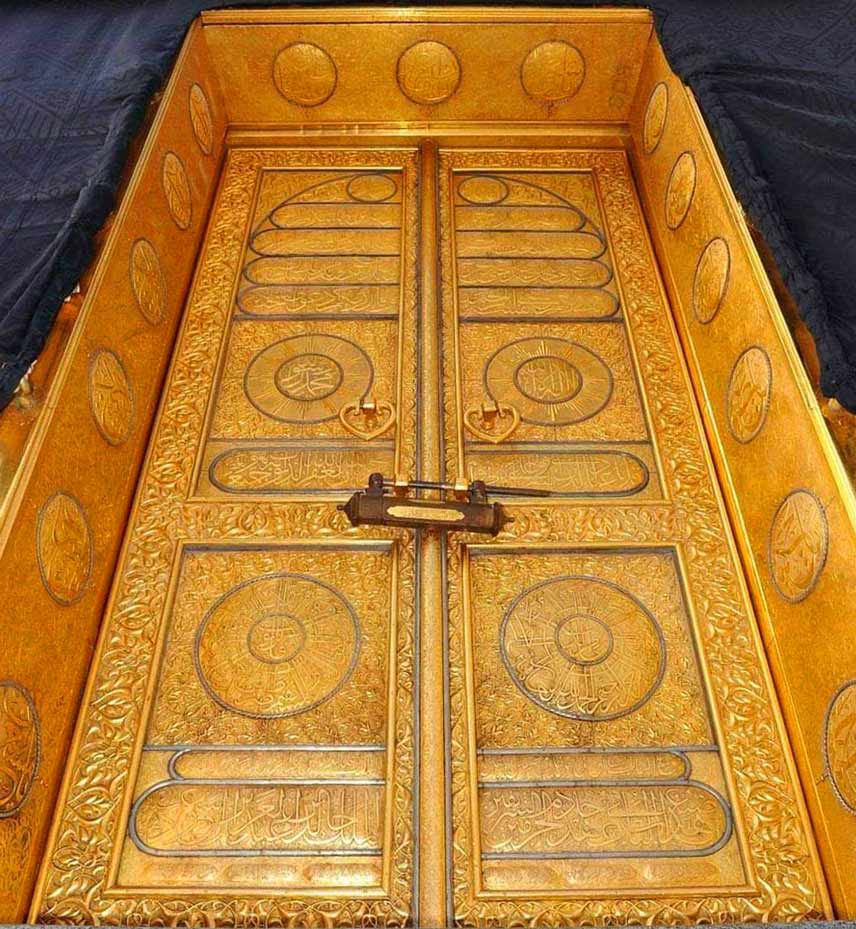
The current door’s gold panels are inlaid with verses from the Quran and the names of Allah and the Prophet Muhammad ﷺ in elegant Thuluth and Kufic calligraphy. Decorative bands frame each panel — the design follows the classical Islamic principle of geometry and calligraphy without any figurative imagery.
The Lock and the Keys: Bani Shaybah
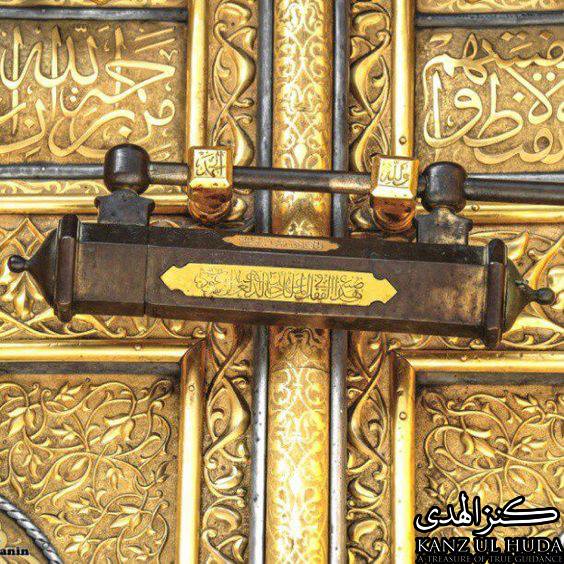
The keys to the Kaaba’s door are held by the Bani Shaybah family — a privilege the Prophet Muhammad ﷺ confirmed for them after the conquest of Makkah. On that day, he handed the key to Uthman ibn Talha and said:
“Take it, Oh Bani Talha, eternally up to the Day of Resurrection, and it will not be taken from you unless by an unjust, oppressive tyrant.”
For more than 1,400 years the keepership has passed down through their male line without interruption. Even the Saudi king must obtain permission from the current keeper of the keys to open the door. The lock itself is large, ornate, and visible above the threshold of the door whenever the Kaaba is closed.


The Three Pillars Inside
The interior of the Kaaba is held up by three wooden pillars arranged in a single line down the middle of the chamber, running north to south. Each pillar is approximately 9 metres tall and 44 centimetres in diameter, with about 2.35 metres of spacing between them. The wood is aged dark hardwood — historical sources name both teak and sandalwood at different periods of restoration. The pillars have been treated with perfume oils across the centuries, contributing to their distinctive aged appearance.

Photographs taken during the annual cleaning show the pillars wrapped in green and gold cloth at their bases. Hanging between and around the pillars are lamps and incense burners made of copper, silver, and glass — many are Ottoman-era pieces; others were gifts from caliphs, sultans, and kings across history. Each lamp is engraved with verses of the Quran.
Between two of the pillars, near the rear of the chamber, is a small low table holding ceremonial items used during the annual washing — including a sealed box of oud (agarwood) oil, Ta’if rose oil, and silver incense burners.
The Marble Flooring and Walls

The floor of the Kaaba is laid with white marble bordered by a strip of black marble. The walls are clad in rose-coloured marble up to roughly 4 metres, then covered above that — for about 5 more metres up to the ceiling — with green silk embroidered in silver and gold with verses of the Quran. The cloth also drapes the entire ceiling. The lower marble is engraved in places, and the upper silk is replaced periodically.
Set into the walls are roughly ten inscribed marble tablets recording the names of the rulers and caliphs who funded restorations of the Kaaba over the centuries. Nine are written in elegant Thuluth script and one in the older Kufic script. The most recent tablet sits on the eastern wall and commemorates the major mosque expansion under King Fahd. These are historical records, not objects of veneration — Islam strictly forbids any form of worship of objects, even those inside the Kaaba itself.
Two darker marble slabs set into the floor mark spots of historical significance: one indicates where the Prophet Muhammad ﷺ prayed two rakahs after the conquest of Makkah, and the other marks the place near the wall where the Prophet ﷺ leaned during a long supplication.
A Cross-Section: What’s Where Inside
If you stood inside the Kaaba facing east toward the door, you would see — front to back — the three teak pillars in a north-south line, marble underfoot, marble-clad lower walls with the six inscribed tablets, green-and-gold silk above, and gold and silver lamps hanging from the ceiling. To the rear-left (north-west) corner is a smaller golden door, Bab al-Tawbah, opening onto a narrow staircase that leads up to the roof. There are no windows; the only light comes from the lamps.
Bab al-Tawbah: The Door to the Roof

In the north-west corner of the interior is a smaller door called Bab al-Tawbah — “the Door of Repentance.” It opens onto a narrow staircase of 50 steps in aluminium and crystal that leads up to the roof of the Kaaba. The staircase is used by maintenance workers during the annual washing ceremony and during the changing of the Kiswa. It was last renovated in 1417 AH (1996 CE) under King Fahd.
The name Bab al-Tawbah does not come from any specific hadith — it is a popular naming. The door itself is plated in gold, like the main entrance.
The Multazam and the Black Stone Corner
Two adjacent features on the outside of the Kaaba deserve mention because they’re often confused with the interior: the Multazam and the Black Stone (Hajar al-Aswad).
- The Black Stone (Hajar al-Aswad) is set into the eastern corner of the Kaaba at chest height. It was brought down from Paradise according to authentic narrations. Over the centuries the original stone has broken into several pieces — they are now held together by a heavy silver band shaped like a frame. The Prophet ﷺ kissed the stone during his Hajj, and pilgrims kiss or point toward it during tawaf.
- The Multazam is the wall section between the Black Stone corner and the main door. Pilgrims press their chests, faces, and outstretched arms against this wall to make personal duas — a practice supported by the actions of several Companions. It is one of the most emotionally powerful spots of the entire pilgrimage.
Neither feature is inside the Kaaba — both are on its outer eastern wall, which means every pilgrim performing tawaf passes them on every revolution.
Hijr Ismail: The Hateem Beside the Kaaba
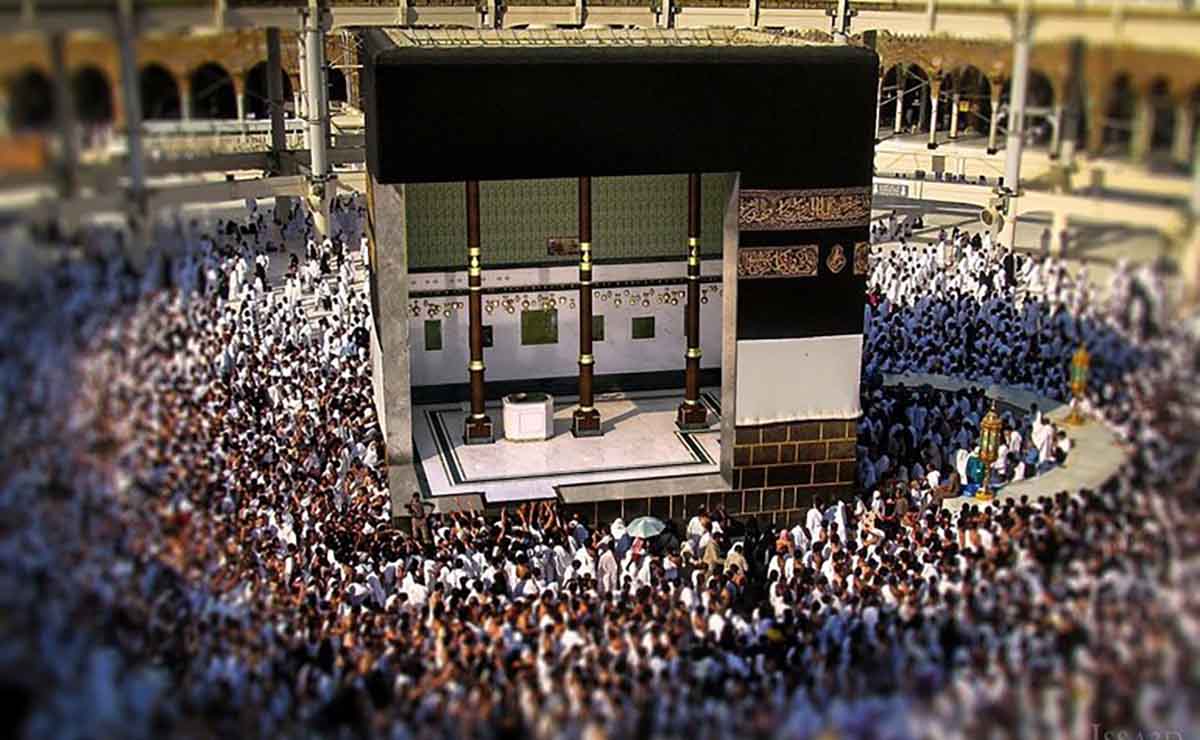
The Hijr Ismail — also called the Hateem — is the crescent-shaped low wall on the north-west side of the Kaaba. It marks the area where the Prophet Ibrahim built a shelter for his wife Hajar and son Isma’il. Crucially, part of the Hateem is technically part of the Kaaba, which is why pilgrims performing tawaf must walk around the outside of the Hateem and not between it and the Kaaba’s wall.

When the Prophet ﷺ was 35 years old, a flood damaged the Kaaba and the Quraysh decided to rebuild it. They wanted to use only halal resources — no money from usury, prostitution, or theft — and they ran short of clean funds before completing the structure. To preserve the original footprint Ibrahim and Isma’il had laid, they marked the missing portion with a low semicircular wall. That wall became the Hateem we see today.
Aisha (RA) reports that she asked the Prophet ﷺ whether the Hateem was part of the Kaaba. He replied that it was. When she asked why it had not been included inside the walls, he answered: “Because your people (the Quraysh) did not have sufficient funds.” (Sahih al-Bukhari 1583)
In another narration, the Prophet ﷺ took Aisha by the hand and led her into the Hijr to pray, telling her: “Perform salah here if you wish to enter the Kaaba — because this is part of the Baytullah.” (Sunan Abi Dawud 2028) Praying inside the Hateem is therefore considered praying inside the Kaaba itself.
Above the Hateem, on the Kaaba’s roof, is a gold-plated water-spout called Mizab al-Rahmah (“the Spout of Mercy”) that channels rainwater off the roof. Pilgrims often try to stand directly under it during rare Makkan rains.
The Kiswa: The Black Cover of the Kaaba
The Kiswa is the black silk cover that drapes the entire exterior of the Kaaba. It is embroidered in gold thread with verses of the Quran and is replaced once a year. Since 2022, the Saudi authorities have changed the Kiswa on the 1st of Muharram — the Islamic New Year — to keep the work clear of the busy Hajj season. Before 2022, it was changed on the 9th of Dhu al-Hijjah (the Day of Arafah), and earlier still on the 10th of Dhu al-Hijjah (Eid al-Adha).
- Size: approximately 658 m² of fabric in 47 separate pieces, total weight around 670 kg.
- Gold thread: roughly 15 kg of pure gold thread embroidered in Quranic calligraphy.
- Cost: approximately SAR 17 million per cover.
- Made in: the dedicated Kiswa Factory in Makkah; historically the cloth came from Yemen, Iraq, and Egypt.
- Tradition begins: attributed to Prophet Isma’il (AS), who is said to have first covered the Kaaba — about 4,000 years ago.
Historically the Kiswa has not always been black. In the Prophet’s ﷺ time it was white Yemeni cloth. Different caliphs and rulers used red, green, and white before the Abbasid era settled on the black we recognise today. In Egypt, under Muhammad Ali Pasha, the production was institutionalised as a state responsibility before being transferred fully to Saudi Arabia in the twentieth century.
When the Kiswa is replaced, the old cover is cut into pieces. Some are gifted to dignitaries and visiting heads of state; others are distributed to pilgrims as a treasured memento. Until 1937, the date for changing the Kiswa was the 10th of Dhu al-Hijjah; the Saudi authorities moved it to the 9th to avoid disrupting the day of Eid al-Adha.
Surah Al-Fil: How Allah Protected the Kaaba
The most famous instance of the Kaaba’s divine protection is the Year of the Elephant (570 CE) — the same year Prophet Muhammad ﷺ was born. The story is recorded in Surah Al-Fil (Quran 105) and the Sirah literature.
Abraha al-Ashram, the Abyssinian governor of Yemen, had built a grand cathedral in Sana’a and wanted Arab pilgrims to redirect their pilgrimage there instead of to the Kaaba. When the Quraysh rejected him and a Bedouin defiled his cathedral in protest, Abraha raised an army — including a contingent of war elephants — and marched on Makkah to demolish the Kaaba.
On the way, his soldiers seized 200 camels belonging to Abdul Muttalib, the chief of Quraysh and the Prophet’s grandfather. Abdul Muttalib went to Abraha to ask for his camels back. Astonished, Abraha asked why he was talking about camels and not the Kaaba. Abdul Muttalib replied:
“I am the lord of the camels. The House has its own Lord who will protect it.”
Abdul Muttalib told the people of Makkah to take refuge in the surrounding hills and went to the Kaaba to make dua. The next morning, when Abraha’s army advanced, the lead elephant — Mahmud — refused to stand. The Quran continues:
“And He sent against them flocks of birds, throwing stones of baked clay, and made them like eaten straw.” (Quran 105:3-5)
Flocks of small birds — the ababil — appeared from the sea, each carrying three small stones (one in the beak and two in the claws). They dropped the stones onto Abraha’s army, and every stone struck a soldier. The army was destroyed. Abraha himself reached Yemen mortally wounded and died there. The Kaaba stood untouched.
The event is remembered every year by every Muslim child who memorises Surah Al-Fil — five short verses that compress one of Islam’s most dramatic moments of divine intervention.
Who Can Enter the Kaaba?
Entry is extremely restricted. The keys are held by the Bani Shaybah family, and the Saudi king’s permission is also required. The Kaaba is opened only twice a year — once for the official washing ceremony before Hajj (called Ghusl al-Ka’bah) and once before Ramadan. On these occasions, the king or his representative leads a small group of dignitaries inside. There is no public access, and there has been no public access in modern history.
The Annual Washing Ceremony (Ghusl al-Ka’bah)

Every year, the inside of the Kaaba is ceremonially washed. The ritual follows a documented procedure:
- The interior is sprayed with rose water (specifically rose water from Ta’if).
- The walls and floor are wiped with cloths soaked in oud (agarwood) oil and Zamzam water.
- The marble tablets and pillars are dusted and the floor is mopped.
- The lamps are lowered, cleaned, and rehung.
- Prayers are offered inside in different directions to symbolise that within the Kaaba, every direction faces Allah.
The Prophet Muhammad ﷺ entered the Kaaba on the day of the conquest of Makkah and prayed inside it. Sahih al-Bukhari 397 records that Bilal accompanied him and reported that the Prophet ﷺ prayed two rakahs between the two pillars at the front of the chamber. This is the basis for entering and praying at the same spot during the modern ceremony.
Common Myths About the Inside of the Kaaba
Several persistent myths circulate online. None of them is accurate.
- Myth: The bodies of prophets are buried inside. False. The Kaaba is empty of any graves. Burying anyone inside the Kaaba would be strictly forbidden in Islamic law, and no historical record places a tomb there.
- Myth: There is treasure or gold hoarded inside. False. The lamps and door are gold; that is all. The Kaaba is a place of worship, not a vault.
- Myth: Hajar al-Aswad (the Black Stone) is inside. False. The Black Stone is set into the outside south-east corner, at hand-height, where pilgrims kiss or point to it during tawaf.
- Myth: The Kaaba has windows. False. There are no windows. The single ground-level door and the staircase to the roof are the only openings.
- Myth: Anyone can enter for the right price. False. There has been no commercial entry to the Kaaba’s interior at any time in Islamic history.
- Myth: The Kiswa is woven in one piece. False. It is 47 separate panels stitched together; each panel is changed individually if it is damaged.
A Note on Photos
The few authentic photographs of the Kaaba’s interior come from the official Saudi General Presidency for the Affairs of the Two Holy Mosques. They appear in state media coverage of the annual washing ceremony. Many images circulating online claiming to be “inside the Kaaba” are AI-generated, photoshopped, or photos of other historical buildings. When in doubt, the source matters — only Saudi state coverage is verifiably authentic.
Why the Kaaba Matters
The Kaaba is not worshipped — Allah is. The Kaaba is the qiblah, the unified direction every Muslim faces. Standing on a roof anywhere in the world, every Muslim in prayer is pointing toward this single cube in Makkah. That visible unity, repeated five times a day for fourteen centuries, is what the Kaaba is for.
The Quran says: “Indeed, the first House [of worship] established for mankind was that at Bakkah — blessed and a guidance for the worlds” (Quran 3:96). Whatever is inside or around the walls — pillars, lamps, marble, the Hateem, the Kiswa — is secondary to that fact.
Frequently Asked Questions
What is inside the Kaaba?
Three wooden pillars running north-to-south down the centre (each about 9 metres tall), white marble flooring with a black marble border, rose-coloured marble walls clad up to about 4 metres with green silk above to the ceiling, around ten inscribed marble tablets recording past restorations (nine in Thuluth script, one in Kufic), copper-silver-and-glass lamps hanging from the ceiling, and a small golden door (Bab al-Tawbah) leading to a staircase of 50 aluminium-and-crystal steps to the roof. There is no furniture, no graves, and no treasure.
What is the Kaaba’s door made of and who guards the keys?
The current door was installed in 1979 and is made of 280 kg of pure gold, valued at roughly $12 million. Its dimensions are 310 cm tall, 170 cm wide, and 50 cm thick. The keys have been held by the Bani Shaybah family for over 1,400 years — the Prophet Muhammad ﷺ confirmed this guardianship after the conquest of Makkah, and even the Saudi king must request permission from them to open the door.
What is the Hijr Ismail or Hateem? Is it part of the Kaaba?
The Hijr Ismail (also called the Hateem) is the crescent-shaped low wall on the north-west side of the Kaaba. Yes — part of it is technically part of the Kaaba’s original footprint, which is why pilgrims performing tawaf must walk around the outside of it. The Prophet ﷺ told Aisha (RA) that praying inside the Hateem counts as praying inside the Kaaba itself (Sunan Abi Dawud 2028).
What is the Kiswa and how often is it changed?
The Kiswa is the black silk cover with gold-embroidered Quranic verses that drapes the Kaaba. It is replaced once a year on the 9th of Dhu al-Hijjah, the Day of Arafah. It weighs about 670 kg, contains 47 panels of fabric and roughly 15 kg of pure gold thread, and costs around SAR 17 million per cover. The colour was historically white, red, and green before becoming black under the Abbasids.
How was the Kaaba protected in the Year of the Elephant?
In 570 CE — the year the Prophet ﷺ was born — the Abyssinian governor Abraha marched on Makkah with an army of war elephants to demolish the Kaaba. The lead elephant refused to advance, and Allah sent flocks of birds (ababil) carrying small stones of baked clay that destroyed the army. The event is recorded in Surah Al-Fil (Quran 105). The Kaaba was untouched.
Did Prophet Muhammad enter the Kaaba?
Yes. After the conquest of Makkah, the Prophet ﷺ entered the Kaaba and prayed two rakahs between the two pillars at the front. Bilal reported the position. This is recorded in Sahih al-Bukhari 397.
The Kaaba is the most photographed building in the Muslim world from the outside — and one of the least photographed from the inside. What is there is intentionally simple: pillars, marble, lamps, a small inner door, and the awareness that Allah, not the building, is what is being worshipped.
Related Reading
- Surah Al-Fil (Quran 105) — the five verses recounting the Year of the Elephant.
- Zamzam Water — Story, Dua & 6 Surprising Benefits — the well that flows beside the Kaaba and is used in its annual washing.
- Zamzam Well — Everything About the Miracle Well — the deeper history of the well of Hajar and Isma’il.
- 8 Things to Do in Dhul Hijjah — the season of Hajj and the Day of Arafah.
- Rabbana Taqabbal Minna — the dua Ibrahim and Isma’il said while raising the foundations.